
NIS2, DORA and CER: which rule applies when?
NIS2 is the broad cybersecurity rule, DORA covers the financial sector and CER covers the resilience of critical entities. Here is which one applies to you, and when more than one does.


Last updated: 16 November 2026
Meridian Nordic is a Danish energy group with a power distribution company and a subsidiary authorised as a payment institution. Meridian Nordic is fictional, but its questions are real. One spring morning the compliance team got three of them at once. Are we covered by NIS2? Does DORA apply to the payment institution? And will the authorities identify the grid company as critical under the CER Directive?
The three rules overlap, but they don't do the same job. This article sorts out which one applies when, and where one takes precedence over another. If you need the basics of NIS2 first, start with our NIS2 guide.
The short answer
NIS2 is the broad EU cybersecurity rule for medium-sized and large organisations in critical sectors. DORA covers financial entities and takes precedence over NIS2 as a sector-specific act. CER is about the overall resilience of critical entities, physical as well as digital, and an entity identified as critical under CER is always an essential entity under NIS2.
Regulation or directive: what kind of rules are these?
Before comparing what the rules require, it helps to know what kind of legal act each one is. That decides where you read the actual requirements.
| Rule | Legal act | Type | How it applies |
|---|---|---|---|
| NIS2 | Directive (EU) 2022/2555 of 14 December 2022 | Directive | Through national law. Member states had to apply their measures from 18 October 2024 (article 41) |
| DORA | Regulation (EU) 2022/2554 of 14 December 2022 | Regulation | Directly in every member state, from 17 January 2025 |
| CER | Directive (EU) 2022/2557 of 14 December 2022 | Directive | Through national law. Member states had to apply their measures from 18 October 2024 (article 26) |
In practice this means two things. For DORA you read the regulation itself and the technical standards that go with it. For NIS2 and CER you read the Danish law that implements them, because that is what the Danish authorities supervise against.
NIS2, DORA and CER side by side
| NIS2 | DORA | CER | |
|---|---|---|---|
| Who it covers | Medium-sized and large entities in the sectors in annexes I and II, and some entities regardless of size | Financial entities such as credit institutions, payment institutions, investment firms, insurance undertakings and crypto-asset service providers (article 2(1)) | Entities that a member state identifies as critical in the sectors listed in the annex |
| Focus | Cybersecurity of network and information systems | Digital operational resilience: ICT risk, ICT-related incidents, resilience testing and ICT third-party risk | Resilience in the broad sense: preventing incidents, physical protection, response, recovery and employee security (article 13) |
| Incident reporting | Early warning within 24 hours, notification within 72 hours and a final report within one month (article 23) | Initial notification within 4 hours of classifying an incident as major and no later than 24 hours after becoming aware of it, an intermediate report within 72 hours and a final report within one month (article 19 and Delegated Regulation (EU) 2025/301, article 5) | Initial notification no later than 24 hours after becoming aware of an incident, followed where relevant by a detailed report within one month (article 15) |
| In Danish law | The NIS2 Act (Act no. 434 of 6 May 2025) and sector laws for energy and telecoms. For finance, the Financial Business Act, aligned with DORA | Applies directly as a regulation | The CER Act (Act no. 433 of 6 May 2025) and, for energy, Act no. 258 of 6 March 2025 |
| Authority in Denmark | Sector authorities, with SAMSIK coordinating | Finanstilsynet, the Danish Financial Supervisory Authority | The competent authorities, which also identify the critical entities |
Which rule applies to you? Three questions
- Are you a financial entity under DORA? Then DORA governs your ICT risk management and incident reporting. The NIS2 rules on those subjects do not apply to you, and in Denmark you do not register under the NIS2 Act.
- Have you been identified as a critical entity? Then CER applies, and you are also an essential entity under NIS2, whatever your size. Banking, financial market infrastructure and digital infrastructure are the exception, because large parts of CER do not apply there.
- Are you in a NIS2 sector and big enough? Then NIS2 applies, through the Danish NIS2 Act or a sector law such as the one for energy.
The answers can all be yes at once, just in different companies in the same group. That is Meridian Nordic's situation. Each organisation has to assess its own status, and SAMSIK's guidance is the natural place to start in Denmark.
NIS2 and DORA: when does DORA take precedence?
NIS2 article 4 is the rule that sorts this out. Where a sector-specific EU act requires essential or important entities to take cybersecurity risk-management measures or to notify significant incidents, and those requirements are at least equivalent in effect, the matching NIS2 provisions do not apply to those entities. That includes supervision and enforcement under chapter VII.
Article 4(2) sets the bar. Risk-management measures count as equivalent when they are at least equivalent in effect to NIS2 article 21(1) and (2). Incident notification counts when it is at least equivalent to article 23(1) to (6), and the NIS2 authorities, CSIRTs or single points of contact get immediate access to the notifications.
DORA settles the question itself. Article 1(2) says that for financial entities identified as essential or important entities under the national rules transposing NIS2 article 3, DORA is a sector-specific Union legal act for the purposes of NIS2 article 4.
NIS2 recital 28 says the same from the other side. DORA's provisions on ICT risk management, ICT-related incidents and major incident reporting, resilience testing, information sharing and ICT third-party risk apply instead of those in NIS2. Member states should therefore not apply NIS2's rules on risk management, reporting, supervision and enforcement to financial entities covered by DORA.
That is why DORA is often called lex specialis to NIS2. Neither text uses the term, but the effect is the same.
How Denmark has done it
- The Danish NIS2 Act does not apply to entities designated under section 333(1) of the Financial Business Act (section 1(2)), or where sector-specific EU acts have at least the same effect (section 1(3)).
- According to SAMSIK's NIS2 FAQ, the financial sector has been implemented in the Financial Business Act, aligned with DORA, and Finanstilsynet is the contact.
- The NIS2 registration duty does not apply to entities covered by DORA.
Recital 28 also keeps a bridge between the two regimes. DORA's authorities can take part in the NIS2 Cooperation Group, and they should pass details of major ICT-related incidents on to the CSIRTs and authorities under NIS2. A bank that reports under DORA is still part of the national cyber picture.
NIS2 and CER: when do both apply?
Here the logic runs the other way. CER doesn't replace NIS2. It adds to it.
NIS2 article 3(1)(f) makes entities identified as critical entities under CER essential entities, and article 2(3) applies NIS2 to them regardless of size. So a small utility that is identified as critical gets both: CER for resilience in the broad sense, and NIS2 for cybersecurity as an essential entity.
The two directives split the work. NIS2 covers the cybersecurity of network and information systems. CER covers the rest of the resilience picture. Article 13 asks critical entities to take measures to prevent incidents, protect their premises and critical infrastructure physically, respond to and recover from incidents, manage employee security and raise awareness among staff. CER also requires the two directives to be implemented in a coordinated way.
There is one notable exception. Under CER article 8, article 11 and chapters III, IV and VI do not apply to critical entities in banking, financial market infrastructure and digital infrastructure, which are points 3, 4 and 8 of the annex.
When are critical entities identified?
Each member state had to identify its critical entities by 17 July 2026 (CER article 6(1)). In Denmark the competent authorities do this. Once a critical entity has been told about its obligations, it has nine months to carry out its risk assessment, and the obligations in sections 6 to 9 of the CER Act apply ten months after (sections 3(5) and 5(3)).
Identification happens entity by entity. If you think you might be one, ask the authority for your sector.
What it looks like in Denmark
The NIS2 Act and the CER Act are both dated 6 May 2025, and both entered into force on 1 July 2025 together with the new telecoms law.
| Law | What it implements | Who it is for |
|---|---|---|
| Act no. 434 of 6 May 2025 (the NIS2 Act) | NIS2 | Entities in NIS2 sectors that are not covered by a sector law |
| Act no. 433 of 6 May 2025 (the CER Act) | CER | Entities identified as critical |
| Act no. 258 of 6 March 2025 on strengthened preparedness in the energy sector | Both NIS2 and CER | The energy sector, with Executive Order no. 260 of 6 March 2025 |
| Act no. 435/2025 (telecoms) | NIS2 for telecoms | The telecoms sector |
| The Financial Business Act | NIS2 for the financial sector, aligned with DORA | Financial entities, for whom DORA applies directly |
The energy sector is where the rules meet most clearly. One law implements both NIS2 and CER for energy, so a Danish energy company finds its cybersecurity obligations and its broader resilience obligations in the same place. If the company is also identified as critical, it is an essential entity under NIS2 at the same time.
For Meridian Nordic the answer looks like this. The power distribution company falls under the energy sector law. The payment institution falls under DORA and does not register under the NIS2 Act. And if the authorities identify the grid company as critical, it gets the CER obligations on top, as an essential entity under NIS2.
Where the three overlap in practice
The requirements are closer to each other than the legal mechanics suggest. All three expect you to assess your risks, handle and report incidents and understand what you depend on.
| Area | NIS2 | DORA | CER |
|---|---|---|---|
| Risk management | Risk-management measures, including the minimum areas in article 21(2) | An ICT risk management framework (chapter II) | A risk assessment and resilience measures (article 13) |
| Incident reporting | 24 hours, 72 hours, one month | 4 hours after classification and no later than 24 hours, then 72 hours and one month | 24 hours, then one month |
| Suppliers | Supply chain security (article 21(2)(d)) | ICT third-party risk and a register of information on all ICT contracts (article 28(3)) | Alternative supply chains as part of recovery (article 13(1)(d)) |
| What is particular | Management approves and oversees the measures (article 20) | Threat-led penetration testing at least every three years for the entities identified (article 26) | Physical protection of premises and critical infrastructure, and employee security (article 13(1)(b) and (e)) |

Plenty carries over. A risk method, an overview of assets and suppliers, an incident process with clear timestamps and policies approved by management are useful under all three. Do that work once and map it to each rule.
Some of it doesn't. DORA's register of information has its own structure and goes to Finanstilsynet. CER's physical protection and employee security reach well beyond IT. And the reporting deadlines are not the same. DORA's first clock starts when you classify an incident as major, with an outer limit of 24 hours from awareness. CER is triggered by disruption of essential services, not by a cyber incident as such.
One incident can start more than one clock. For a Danish energy company that has been identified as critical, a cyberattack that stops power distribution could be a significant incident under NIS2 and a disruption under CER. Keep one incident log and record the moment you became aware once, so every report starts from the same timestamp.
Sources
- Directive (EU) 2022/2555 (NIS2), EUR-Lex
- Regulation (EU) 2022/2554 (DORA), EUR-Lex
- Commission Delegated Regulation (EU) 2025/301 on the content and time limits of DORA incident reports, EUR-Lex
- Directive (EU) 2022/2557 (CER), EUR-Lex
- Act no. 434 of 6 May 2025 (the NIS2 Act), retsinformation.dk
- Act no. 433 of 6 May 2025 (the CER Act), retsinformation.dk
- SAMSIK's NIS2 FAQ and registration guidance, samsik.dk
How .legal supports NIS2, DORA and CER
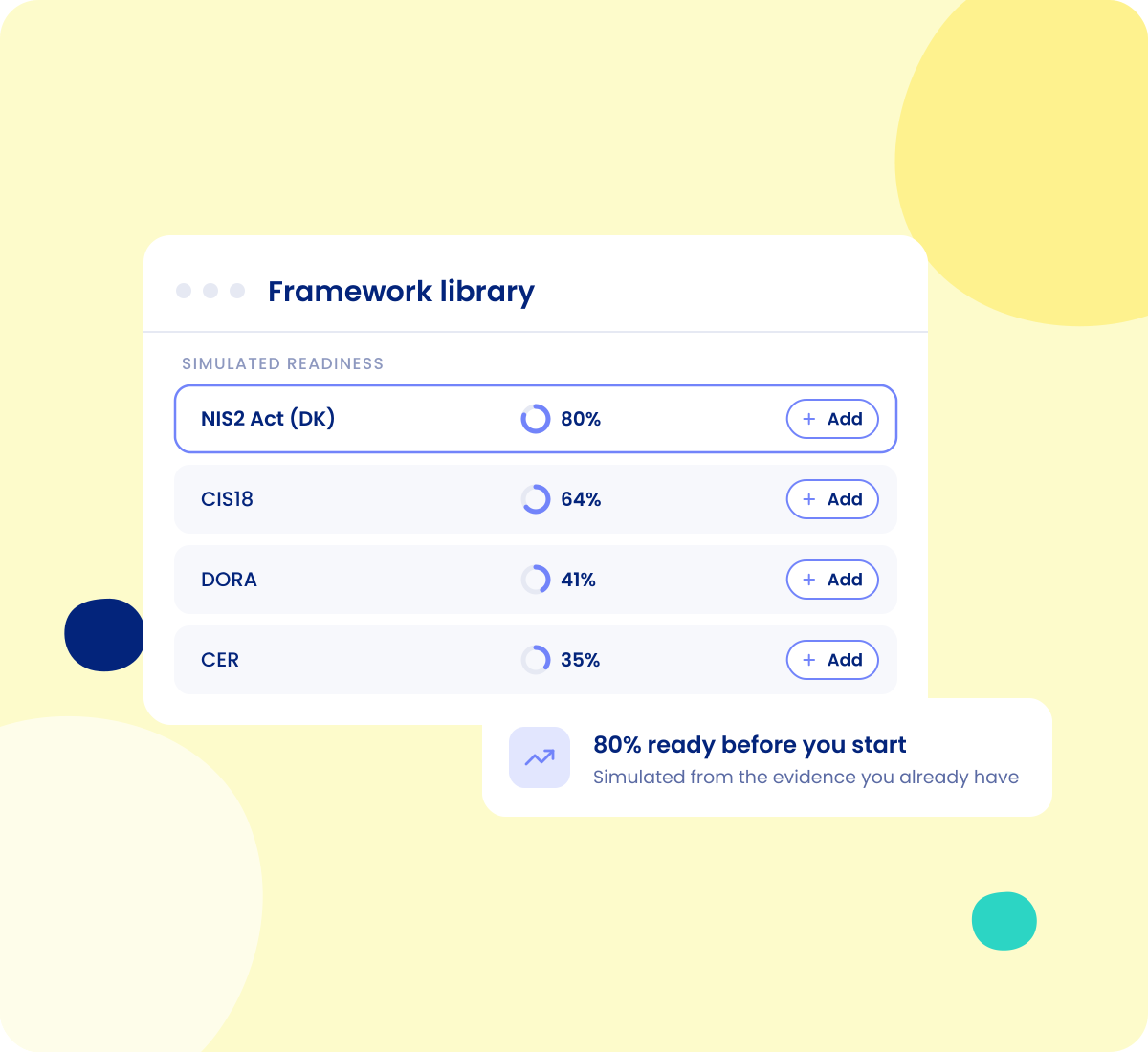
.legal's Information and Cyber Security module comes with framework templates for NIS2 (among them the general requirements, energy, telecoms and the NIS2 Act), CER and DORA. The DORA template has 43 controls and the CER template 14. With the Frameworks module, a completed task gives progress on every control it is linked to, also in NIS2 and ISO 27001, so the shared work is done once.
DORA's register of information can be built in the contract module and exported in a structured Excel format. .legal doesn't decide whether you are covered by NIS2, DORA or CER, doesn't give an overall compliance verdict and doesn't report to Finanstilsynet or any other authority. You can read more about the DORA template and the NIS2 templates in .legal.
Still have questions?
Ask Johannes directly. Book him here.
Related reading on NIS2





.legal compliance platform
Work on NIS2, DORA and CER in the same place
Activate the framework templates you need and link each task to the controls it answers. With the Frameworks module, one completed task gives progress in every framework it is linked to.
-
NIS2 templates, among them the NIS2 Act and energy
-
DORA template with 43 controls
-
CER template with 14 controls
-
Progress across frameworks from one completed task
-
DORA register of information exported to Excel