Last updated: 16 November 2026
Take a utility in a Danish market town that supplies electricity, district heating and drinking water. When it starts work on NIS2, it finds that the NIS2 Act is only part of the picture. Electricity and district heating fall under the energy sector's own act and executive order, supervised by Energistyrelsen. Drinking water falls under the NIS2 Act, with Miljøstyrelsen as the authority. One company, two sets of rules and two authorities.
This article maps how NIS2 works in Denmark: the Act, the executive orders, the sector rules, registration and who supervises whom. For the requirements themselves, read our NIS2 guide.
The short answer
Denmark has implemented the NIS2 Directive through the NIS2 Act (Act no. 434 of 6 May 2025), which has applied since 1 July 2025. Energy, telecoms and finance have their own rules. Entities covered from the start had to register on virk.dk by 1 October 2025, and an essential or important entity covered later has two weeks (digital providers under § 9 have three months).
From EU directive to Danish law
NIS2 is a directive, so it does not bind companies directly. It tells the member states what their national law must achieve, and they had to transpose it by 17 October 2024. In Denmark, that law is the NIS2 Act, supplemented by an executive order and by separate acts for energy and telecoms. On top of that come EU implementing regulations, which apply directly, and guidance from the authorities, which explains the rules without adding to them.
| Type of rule | What it is | Who it binds | Danish example |
|---|
| EU directive | Sets the goals that national law must meet | The member states | Directive (EU) 2022/2555 (NIS2) |
| Danish act | Passed by the Folketing to transpose the directive | Covered entities and the authorities | The NIS2 Act, Act no. 434 of 6 May 2025 |
| Executive order | Detailed rules a minister or agency issues under an act | Those within its scope | Executive Order no. 620 of 2 June 2025 |
| Sector act | A separate act that implements NIS2 for one sector | Entities in that sector | Act no. 258 of 6 March 2025 (energy), Act no. 435 of 6 May 2025 (telecoms) |
| EU implementing regulation | Commission rules that apply directly in every member state | The entity types it names | Implementing Regulation (EU) 2024/2690 for digital providers |
| Guidance | The authorities' explanation of the rules | No one, but it shows how the authorities read the law | SAMSIK's four guides on scope, the role of management, measures and incident notification |
The NIS2 Act in brief
The Act's full name is "Lov om foranstaltninger til sikring af et højt cybersikkerhedsniveau (NIS 2-loven)". The bill was L 141 in the 2024-25 session. The Folketing adopted it on 29 April 2025, and the Act is dated 6 May 2025. These are the sections most organisations need to know:
| Section | What it says |
|---|
| § 1 and Annexes 1 and 2 | The Act covers public and private entities in the sectors listed in the annexes. It does not apply to entities to the extent they are covered by the energy or telecoms acts (§ 1(2)), or where sector-specific EU rules have at least the same effect (§ 1(3)). |
| §§ 4 and 5 | Who counts as an essential entity and who counts as an important entity, based on sector and size. |
| § 6 | The ten minimum measures for managing cybersecurity risks. |
| § 7 | The management body approves the measures, oversees how they are implemented and takes part in training. |
| § 8 | Allows a minister to require certified ICT products, services and processes. It is a power in the Act, not a requirement in itself. |
| §§ 9 and 10 | Registration with the competent authority. |
| §§ 12 and 13 | Incident reporting in three steps: an early warning within 24 hours, an incident notification within 72 hours and a final report within one month of the notification. |
| §§ 21 to 26 | Supervision and enforcement: proactive for essential entities, reactive for important entities. |
| § 32 | Penalties: fines, including for companies as legal persons. |
| § 33 | Entry into force on 1 July 2025 and the registration deadline of 1 October 2025. |
The Act gives you the frame, not the answer for your organisation. Whether you are covered is your own assessment. SAMSIK's guidance on scope and the NIS 2 check are the places to start (both in Danish).
Registration with the authorities
Who must register
Every essential entity and important entity must register (§ 10). Digital providers register under § 9, which asks for a little more, such as the address of the main establishment in the EU. That group covers DNS service providers, top-level domain registries, domain name registration services, cloud, data centre and content delivery network providers, managed service and managed security service providers, online marketplaces, search engines and social networks. Entities covered by DORA do not have to register.
When
| Situation | Deadline | Source |
|---|
| Covered when the Act entered into force | 1 October 2025 | § 33(3) |
| Essential or important entity covered later | 2 weeks after becoming covered | § 10(2) |
| Changes to the information, essential or important entity | 2 weeks after the change | § 10(3) |
| Digital provider under § 9 covered later | 3 months after becoming covered | § 9(2) |
| Changes to the information, digital provider | 3 months after the change | § 9(3) |
One detail is worth knowing. SAMSIK's registration page gives three months for reporting changes and does not split the groups. The Act and SAMSIK's own guidance on scope say two weeks for essential and important entities. Plan for two weeks, and ask your sector authority if you are unsure.
Registration does not decide whether you are covered. The obligations apply from the day you are covered, registered or not, and failing to register can itself be fined (§ 32).
Where and how
Registration is a digital form on virk.dk, which you sign in to with MitID Erhverv. Executive Order no. 620 makes SAMSIK's self-service solution on virk.dk the channel for both registration and incident notification (§ 14). When you submit the form, it goes automatically to the sector authority for each sector you select. An entity active in several sectors makes one combined registration and lists all of them. You report changes by submitting a new form.
What you need to provide
- The entity's name
- The sector, subsector and type of entity under Annex 1 or 2
- Up-to-date contact details, including email addresses, IP ranges and phone numbers
- The EU member states where you provide services
The IP ranges are the part that trips people up. SAMSIK asks for the static public IP addresses of servers you run yourself, including dedicated infrastructure at a cloud provider. Dynamic addresses, employees' home connections and shared services such as Microsoft 365 are left out.
The executive orders
Executive Order no. 620 of 2 June 2025 ties the NIS2 Act together across sectors. It entered into force on 1 July 2025, together with the Act, and does two things. Chapters 1 and 2 name the competent authority for each sector, subsector and type of entity. Chapter 3 requires registration and incident notification to go digitally through virk.dk, signed with MitID.
The Act also lets ministers set more detailed rules, for example on the measures (§ 6(3)), on when an incident is significant (§ 12(3)) and on certified ICT products (§ 8). Check retsinformation.dk for executive orders in your own sector.
Digital providers have one more layer. Commission Implementing Regulation (EU) 2024/2690 sets out the technical and methodological requirements for the measures and when an incident counts as significant. It covers DNS, top-level domain, cloud, data centre and content delivery network providers, managed and managed security service providers, online marketplaces, search engines, social networks and trust service providers. It applies directly, without Danish implementation.
Sectors with their own rules
Energy and utilities
Energy is where the Danish set-up differs most. Its NIS2 requirements are not in the NIS2 Act but in Act no. 258 of 6 March 2025 on strengthened preparedness in the energy sector and Executive Order no. 260 of 6 March 2025 on resilience and preparedness in the energy sector. Both entered into force on 7 March 2025, nearly four months before the NIS2 Act. They implement NIS2 and the CER Directive (EU) 2022/2557 together, so cybersecurity, physical security and preparedness sit in one set of rules. Energistyrelsen supervises.
The energy act covers electricity, gas, oil, hydrogen and district heating and cooling, among others. Small companies can be covered as well, if they pass the act's thresholds. A district heating company with fewer than 50 employees and no more than EUR 10 million in turnover and balance sheet is covered if it sold more than 13.9 GWh of heating or cooling a year in two of the last three years (§ 2(2) of Act no. 258).
Executive Order no. 260 places each company in one of five levels and each installation in one of five classes, based on thresholds in its annexes (§§ 4 and 6). A company active in several subsectors gets the highest level, assessed for each CVR number. Level 1 companies only have to meet a limited part of the order (§ 5). Significant incidents are reported to Energistyrelsen within 24 hours, with a status within 72 hours and a report within one month (§§ 77 and 78).
Water is different. Drinking water and wastewater are in Annex 1 of the NIS2 Act, so a waterworks or wastewater company follows the NIS2 Act, with Miljøstyrelsen as the competent authority (§ 11 of Executive Order no. 620). Waste incineration plants are a third case. They belong to the waste management sector of the NIS2 Act, but Energistyrelsen is their competent authority (§ 5 of the same order).
| Activity | Rules | Competent authority |
|---|
| Electricity | Act no. 258 and Executive Order no. 260 | Energistyrelsen |
| Gas | Act no. 258 and Executive Order no. 260 | Energistyrelsen |
| Oil | Act no. 258 and Executive Order no. 260 | Energistyrelsen |
| Hydrogen | Act no. 258 and Executive Order no. 260 | Energistyrelsen |
| District heating and cooling | Act no. 258 and Executive Order no. 260 | Energistyrelsen |
| Waste incineration | NIS2 Act (Annex 2, waste management) | Energistyrelsen |
| Drinking water | NIS2 Act (Annex 1) | Miljøstyrelsen |
| Wastewater | NIS2 Act (Annex 1) | Miljøstyrelsen |
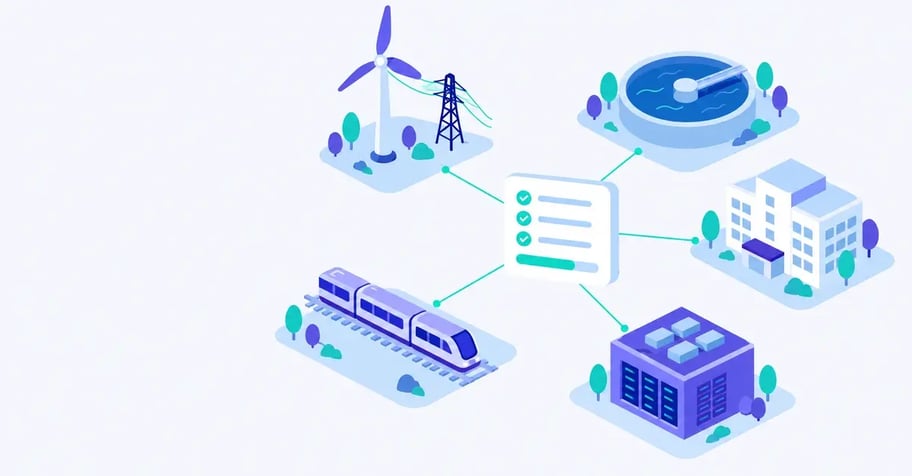
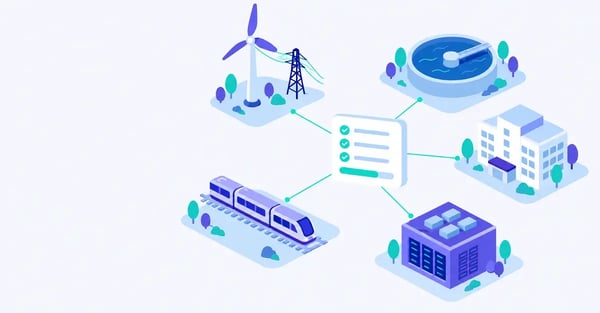
Back to the utility from the introduction. The NIS2 Act only steps aside "to the extent" the energy act covers an entity (§ 1(2)). So its electricity and heating activities follow the energy rules, and its water activity follows the NIS2 Act. In practice that means two sets of requirements to map and two authorities to report to. Our guide to vendor risk management for utilities shows how to handle suppliers across both.
Telecoms
Commercial providers of public electronic communications networks and services follow Act no. 435 of 6 May 2025 on security and preparedness in the telecoms sector, which also entered into force on 1 July 2025. SAMSIK is the authority, and telecoms providers register with SAMSIK. Municipalities and regions that provide such networks are outside the telecoms act (§ 1(2) of that act). Under the NIS2 Act, they are essential entities if they do it on a commercial basis and meet the size criteria (§ 4(2)).
Finance
Banks, insurers and other financial entities follow DORA, the EU regulation on digital operational resilience, and report ICT-related incidents to Finanstilsynet. The NIS2 Act does not apply to entities designated under § 333(1) of the Financial Business Act (§ 1(2)), or where sector-specific EU rules have at least the same effect (§ 1(3)). Entities covered by DORA do not register under the NIS2 Act.
Municipalities and regions
Annex 1 of the NIS2 Act names public administration at central and regional level, not local. Municipalities are still covered, but through what they do. SAMSIK's guidance on scope says a municipality is covered in the same way as any other entity: when it provides services in a NIS2 sector, such as health or transport, and meets the size criteria. On that basis SAMSIK expects all Danish municipalities to be covered. When a municipality is covered, its whole CVR number is covered, even if only one of its areas is in a NIS2 sector.
Executive Order no. 620 makes SAMSIK the competent authority for the municipalities, whichever sectors they work in (§ 1). Municipal companies with their own CVR number, such as a utility, are assessed on their own and can have a different authority. The Act also allows a minister to extend it wholly or partly to local public administration and to educational institutions (§ 1(7)). SAMSIK's guidance bases municipal coverage on their activities, not on that provision.
The regions are all expected to be covered as essential entities, according to SAMSIK, because they provide health services and were identified as operators of essential services under the first NIS Directive. Their competent authority is Sundhedsdatastyrelsen (§ 2 of Executive Order no. 620).
Authorities and supervision
Denmark has no single NIS2 authority. Supervision follows the sector. Each sector authority supervises its own area, Styrelsen for Samfundssikkerhed (SAMSIK) coordinates across them, and the Danish Defence Intelligence Service (Forsvarets Efterretningstjeneste) is the national CSIRT.
| Authority | Sectors and entities | Source |
|---|
| Styrelsen for Samfundssikkerhed (SAMSIK) | Municipalities, central government, vessel traffic services, internet exchange points, chemicals and parts of manufacturing (electronics, electrical equipment, machinery and vehicles). Telecoms under the telecoms act | Executive Order no. 620, §§ 1 and 12, and Act no. 435 |
| Sundhedsdatastyrelsen | Regions, health and medical devices | Executive Order no. 620, §§ 2 and 4 |
| Energistyrelsen | Energy under the energy act, and waste incineration under the NIS2 Act | Act no. 258, Executive Order no. 260 and Executive Order no. 620, § 5 |
| Digitaliseringsstyrelsen | Cloud, data centres, DNS, top-level domains, content delivery networks, trust services, managed and managed security services, online marketplaces, search engines and social networks | Executive Order no. 620, § 6 |
| Trafikstyrelsen | Air, rail and road transport, ports, postal and courier services, Banedanmark and Vejdirektoratet | Executive Order no. 620, § 7 |
| Søfartsstyrelsen | Shipping companies | Executive Order no. 620, § 8 |
| Uddannelses- og Forskningsstyrelsen | Space and research | Executive Order no. 620, § 9 |
| Klimadatastyrelsen | Space activities of agencies under the Ministry of Climate, Energy and Utilities | Executive Order no. 620, § 10 |
| Miljøstyrelsen | Drinking water, wastewater and waste management other than incineration | Executive Order no. 620, § 11 |
| Fødevarestyrelsen | Food production and wholesale | Executive Order no. 620, § 13 |
| Finanstilsynet | Financial entities under DORA | DORA |
Supervision depends on the category. Essential entities are supervised proactively, with inspections, security audits and scans (§ 21). Important entities are supervised reactively, when there are signs that they do not comply (§ 24). Breaches are punished with fines under § 32, decided by the courts under Danish criminal law, and companies can be held liable as legal persons. The directive sets the maximum fine at no less than EUR 10 million or 2% of worldwide annual turnover for essential entities, and EUR 7 million or 1.4% for important entities. Read more about sanctions under NIS2.
How to get started
- Find out whether you are covered. Use SAMSIK's guidance on scope and the NIS 2 check. If you work in energy, telecoms or finance, check the sector rules first.
- Register on virk.dk. If you are covered and have not registered yet, do it now, and make someone responsible for reporting changes within two weeks.
- Map the requirements that apply to you. That can be the NIS2 Act for some activities and the energy rules for others. Our NIS2 implementation guide takes you through the work in 12 steps.
How .legal supports the NIS2 Act
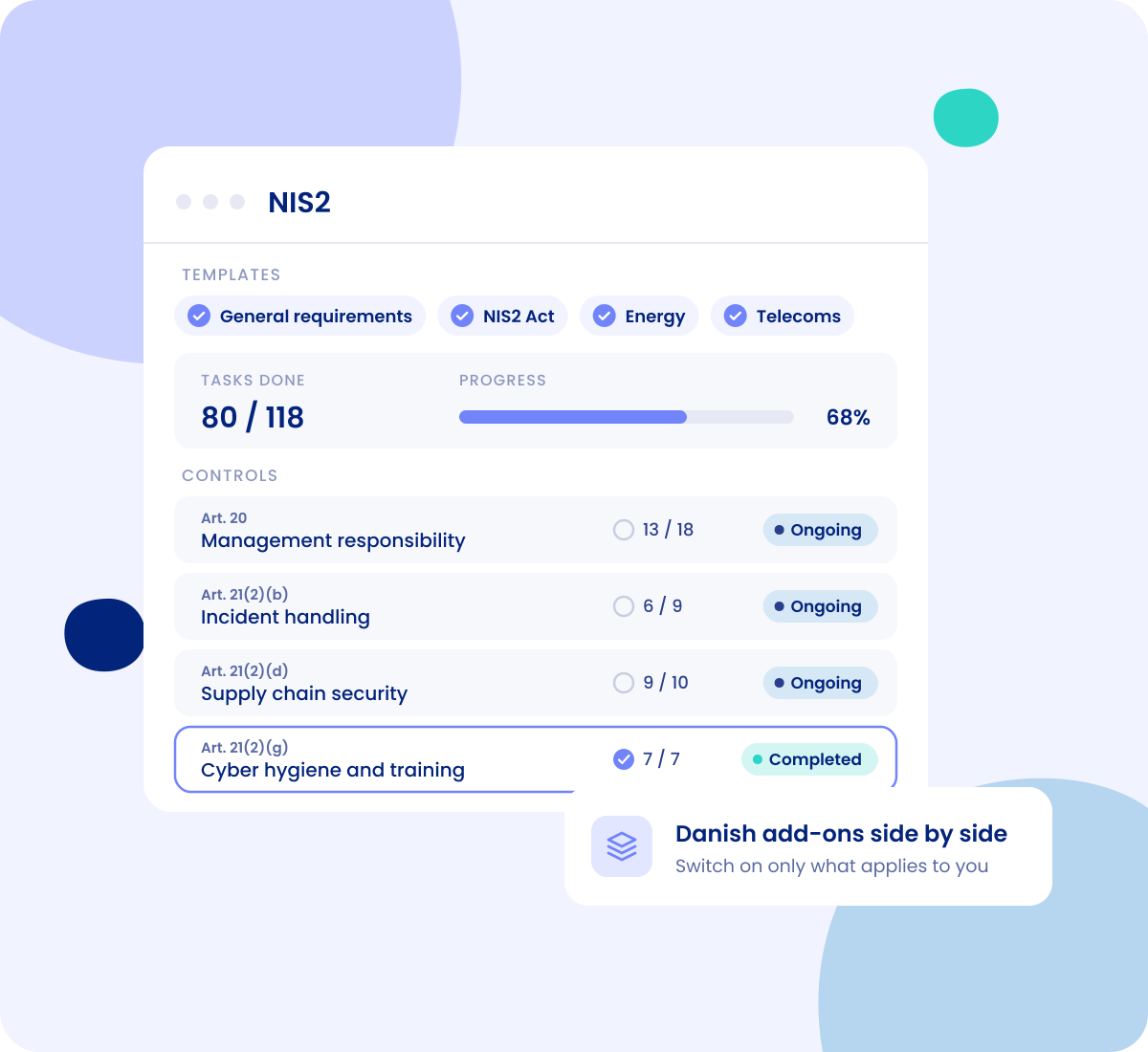
.legal does not decide whether you are covered, and it does not report to the authorities for you. Registration and incident notification happen on virk.dk. What .legal gives you is the structure for the work. The base package (NIS2: general requirements) and the Danish add-on templates for the NIS2 Act, energy and telecoms can be switched on side by side, so a utility can work with the NIS2 Act and the energy rules in one place. The templates come with the Information and Cybersecurity module. When an incident happens, you can record when it occurred and when it was reported, and upload the receipt. See the NIS2 templates in .legal.
Still have questions?
Ask Johannes directly. He gives most of our demos himself. Book him here.
Sources