
ISO 27001 compliance and certification: what the standard requires and what the certificate proves
ISO 27001 compliance means meeting the requirements of the standard. ISO 27001 certification is an accredited body confirming that you do. Here is the difference, the requirements in clauses 4 to 10 and Annex A, what a certificate really covers, and what the three-year cycle costs.

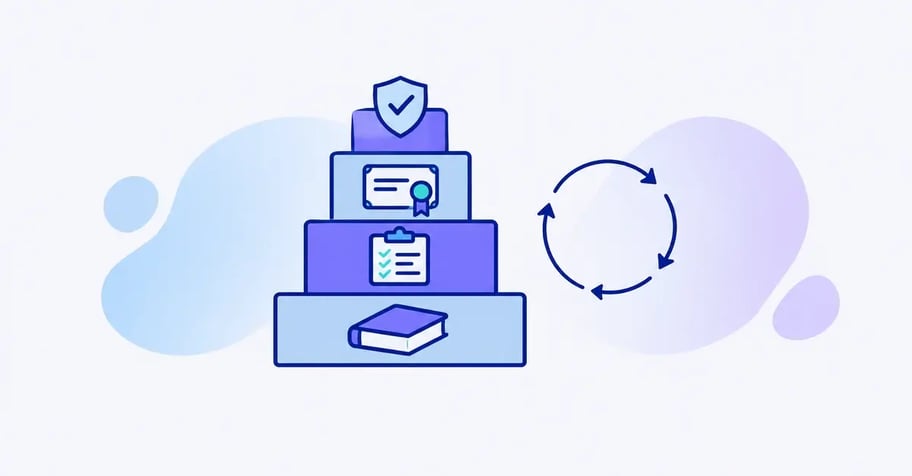
A customer writes ISO 27001 into a tender. The board asks whether you are "ISO 27001 compliant". A supplier sends over a certificate and nobody is quite sure what it proves. Three situations, one standard, three different questions.
This article answers all three. It explains what ISO/IEC 27001:2022 requires, the difference between complying with the standard and being certified against it, what a certificate actually covers, and what the three years of a certification cycle cost. The step-by-step route is in our practical guide to ISO 27001 certification, and the full list of requirements is in our ISO 27001 checklist. This page is about understanding what you are signing up for before you start.
The figures come from ISO, the ISO Survey 2024, the accreditation rules in ISO/IEC 27006-1, the NIS2 Directive, the GDPR, UK and European certification bodies and the UK Parliament, and we say which.
The short answer: what is ISO 27001 compliance, and what is ISO 27001 certification?
ISO 27001 compliance means your organisation meets the requirements of ISO/IEC 27001:2022. You run an information security management system (ISMS) that satisfies clauses 4 to 10, and you have taken a documented position on all 93 Annex A controls in a Statement of Applicability. You can do that without ever meeting an auditor.
ISO 27001 certification means a certification body, accredited by a national accreditation body such as UKAS in the United Kingdom or DANAK in Denmark, has carried out a two-stage audit and issued a certificate confirming that your ISMS conforms to the standard within a defined scope. The certificate is valid for three years with a surveillance audit each year.
The difference is the evidence. Compliance is something you assert and can document. Certification is something an independent third party confirms. Customers, tenders and supplier assessments almost always ask for the second, because it is the only one of the two they can check without auditing you themselves. Neither makes you GDPR or NIS2 compliant on its own, but both cover a large share of the security work those laws require.
Three things that get mixed up
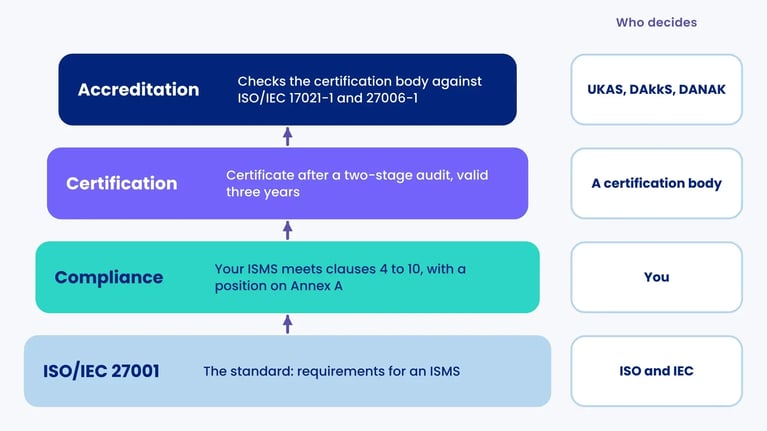
Search queries around ISO 27001 treat the standard, compliance with it and the certificate as one thing. They are three things built on top of each other, and a fourth, accreditation, decides whether the certificate is worth showing anyone.
| Term | What it is | Who is behind it | Can you prove it to others? |
|---|---|---|---|
| The standard, ISO/IEC 27001 | A document setting requirements for an ISMS. The current edition is 2022, adopted in Europe as EN ISO/IEC 27001:2023 | ISO and IEC. Bought from ISO or your national standards body, it is not free | No, it is a text, not a status |
| ISO 27001 compliance | Your ISMS meets clauses 4 to 10 and you have taken a position on Annex A | You | Only by showing documentation or being audited |
| ISO 27001 certification | A certificate issued after a two-stage audit, valid three years within a defined scope | A certification body | Yes, the certificate and scope statement can be sent to customers |
| Accreditation | Confirmation that the certification body itself meets ISO/IEC 17021-1 and ISO/IEC 27006-1 | UKAS in the UK, DAkkS in Germany, DANAK in Denmark, and their peers | Yes, the accreditation mark is on the certificate and the certificate can be looked up in IAF CertSearch |
The last row is the one most people skip. Any company may legally issue an "ISO 27001 certificate". The National Cyber Security Centre makes exactly this point: only bodies accredited by UKAS are covered by the international peer review that makes their assessments independent and recognised across borders. When you assess a supplier's certificate, look for the accreditation mark and look the certificate up.
What is ISO 27001?
ISO/IEC 27001 is the international standard for an information security management system. It is published jointly by ISO and IEC. The third edition, ISO/IEC 27001:2022, was published in October 2022, and Amendment 1 from 2024 added climate change as a factor the organisation must consider under clauses 4.1 and 4.2. Annex A was not changed.
The transition from the 2013 edition closed on 31 October 2025. Every 2013 certificate has expired, and any valid certificate today is issued against the 2022 edition. The vocabulary standard ISO/IEC 27000 was republished on 3 July 2026, but it does not change the requirements in 27001 and does not affect the validity of existing certificates.
The standard is built around three properties of information: confidentiality, integrity and availability. It is not a list of technical requirements. It describes a management system that forces the organisation to know its risks, decide how to treat them and prove that the decisions are followed through. That is why ISO 27001 is equally relevant to a manufacturer, a local authority and a SaaS provider, even though their controls look very different.
It is also widely used. The ISO Survey 2024, the most recent published edition, counts 96,709 valid certificates covering 179,877 sites worldwide. The United Kingdom has 4,445 certificates, the fourth highest number of any country after China, India and Japan. Germany has 2,444 and the Netherlands 1,568. In the UK the standard is what larger customers, public procurement and international partners ask for by name, and it is the natural backbone for organisations covered by NIS2 in the EU.
ISO 27001 compliance requirements: clauses 4 to 10
The requirements for the management system itself sit in clauses 4 to 10. All of them are mandatory. You cannot exclude a clause the way you can exclude an Annex A control. The table shows what each clause requires and what an auditor typically asks to see.
| Clause | What it requires | Typical audit evidence |
|---|---|---|
| 4 Context of the organisation | Understand internal and external issues (4.1), interested parties' requirements including legislation (4.2), define the scope of the ISMS (4.3) and establish the system (4.4) | Scope statement, stakeholder analysis, register of legal requirements |
| 5 Leadership | Top management commitment (5.1), information security policy (5.2), roles, responsibilities and authorities (5.3) | Signed policy, meeting minutes, security organisation chart |
| 6 Planning | Risk assessment (6.1.2), risk treatment with a Statement of Applicability (6.1.3), measurable security objectives (6.2), planning of changes (6.3, new in 2022) | Risk methodology, risk register, risk treatment plan, SoA, objectives |
| 7 Support | Resources (7.1), competence (7.2), awareness (7.3), communication (7.4), control of documented information (7.5) | Training log, competence matrix, document control with versions |
| 8 Operation | Carry out what was planned (8.1), risk assessment at planned intervals (8.2), implement the risk treatment plan (8.3) | Completed risk assessments, status of treatment actions, supplier management |
| 9 Performance evaluation | Monitoring and measurement (9.1), internal audit (9.2), management review (9.3) | Audit programme, audit reports, management review minutes |
| 10 Improvement | Continual improvement (10.1), nonconformity and corrective action (10.2) | Nonconformity log with root cause analysis and closed actions |
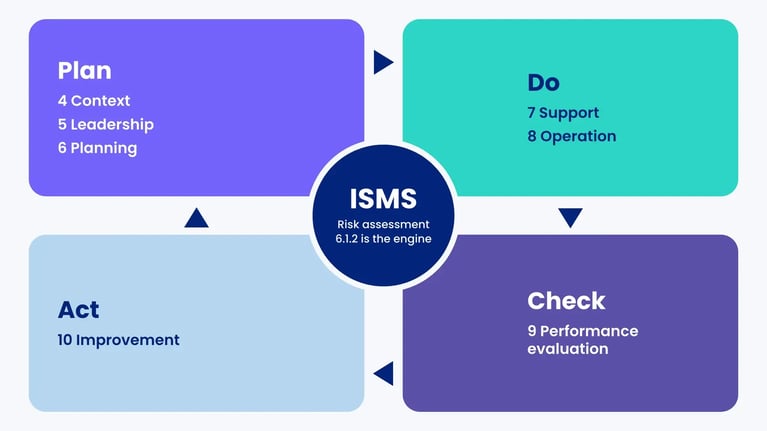
Read the table as a cycle, not a list. Clauses 4 to 6 plan, 7 and 8 do, 9 measures and 10 corrects. That cycle is what separates a management system from a folder of policies, and it is what the auditor looks for evidence of. An organisation that has written every document but has never held an internal audit or a management review is not ISO 27001 compliant, however good the documents are.
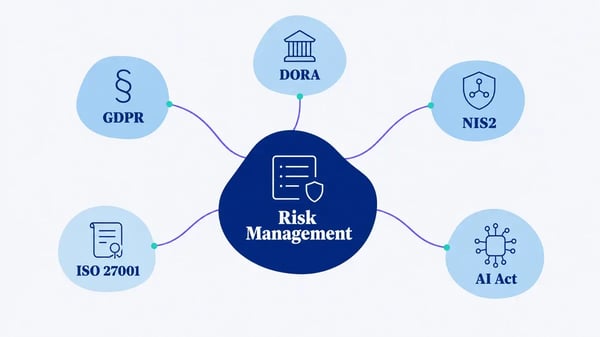
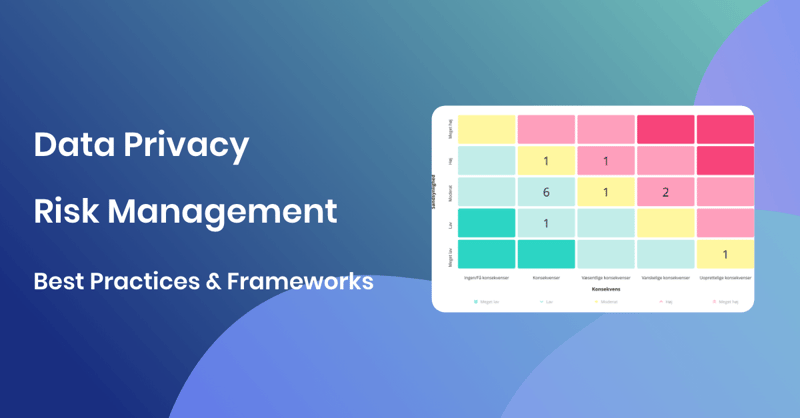
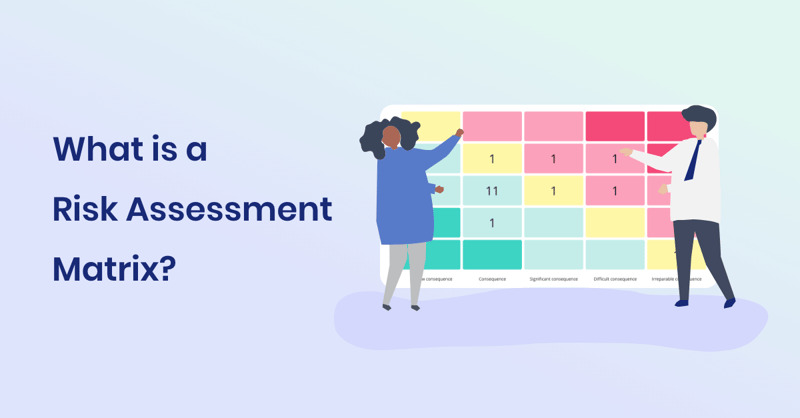
The risk assessment in clause 6.1.2 is the engine. Everything else, from the choice of controls to the order in which budget is spent, has to trace back to it. Our article on information security risk management shows how one method can serve ISO 27001, the GDPR, NIS2 and DORA at the same time.
Annex A: 93 controls and the Statement of Applicability
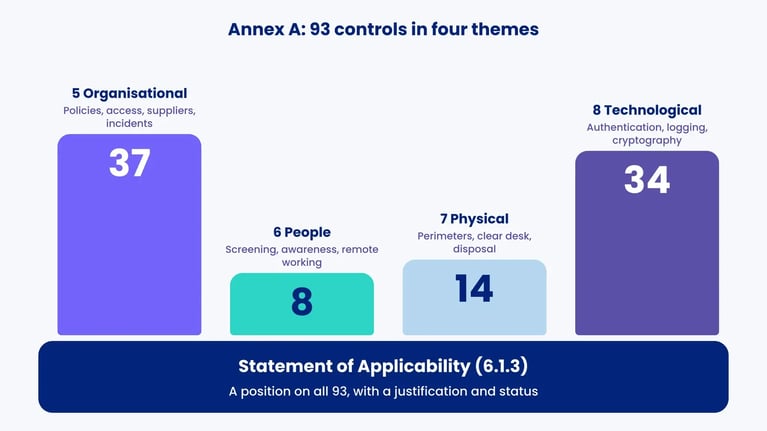
Annex A is the standard's catalogue of reference controls. The 2022 edition consolidated the previous 114 controls in 14 domains into 93 controls in four themes. Eleven controls are new, including threat intelligence (5.7), information security for use of cloud services (5.23), ICT readiness for business continuity (5.30), configuration management (8.9), information deletion (8.10), data masking (8.11), data leakage prevention (8.12), monitoring activities (8.16), web filtering (8.23) and secure coding (8.28).
| Theme | Number of controls | Examples |
|---|---|---|
| 5 Organisational | 37 | Policies (5.1), access control (5.15 to 5.18), supplier relationships (5.19 to 5.23), incident management (5.24 to 5.28), business continuity (5.29 to 5.30), legal and contractual requirements (5.31 to 5.34) |
| 6 People | 8 | Screening (6.1), terms of employment (6.2), awareness and training (6.3), remote working (6.7) |
| 7 Physical | 14 | Physical perimeters (7.1), physical security monitoring (7.4), clear desk and clear screen (7.7), secure disposal (7.14) |
| 8 Technological | 34 | Secure authentication (8.5), vulnerability management (8.8), logging (8.15), cryptography (8.24), secure development (8.25 to 8.31) |
The controls are references, not requirements in themselves. Clause 6.1.3 requires you to compare the controls your risk assessment points to with Annex A and, in a Statement of Applicability (SoA), to take a position on each of the 93 with a justification for inclusion or exclusion and an implementation status. A control can be excluded. What cannot be excluded is the justification. The SoA is also the first document a certification body reads, and it is referenced on the certificate next to the scope statement.
Guidance on how to implement the controls sits in ISO/IEC 27002:2022. It is not certifiable and it cannot buy you out of the risk assessment, but it is where your IT team will look things up.
What an ISO 27001 certificate proves, and what it does not
A certificate is a precise document. It confirms that an accredited body found, at a given point in time, that the ISMS within the stated scope conforms to ISO/IEC 27001:2022. Three things follow from that wording, and they are worth reading aloud both when you pursue a certificate and when you assess someone else's.
Scope decides everything. A certificate covering "the operation of the customer portal at the Manchester site" says nothing about the HR system, the finance function or the subsidiary in Dublin. The scope statement is printed on the certificate and it is the first thing an experienced buyer reads. A narrow scope is not cheating, it is often sensible, but it has to match what the customer is actually buying.
The certificate proves the system works, not that nothing can go wrong. An auditor samples. A certified organisation can suffer a breach, and that does not invalidate the certificate as long as the incident is handled through the system. The standard promises a managed level of risk, not zero risk.
The certificate is not a legal approval. ISO 27001 certification does not in itself satisfy the GDPR, NIS2 or DORA. We come back to this below, because it is the claim we most often see made wrongly in the market.
The certification cycle: three years, four audits
Certification is not an exam you pass once. It is a three-year cycle governed by ISO/IEC 17021-1 and ISO/IEC 27006-1:2024, the standards certification bodies themselves must follow. The step-by-step preparation is covered in our guide to the ISO 27001 certification process. Here is the cycle itself.
| When | Audit | What the auditor does | Effort |
|---|---|---|---|
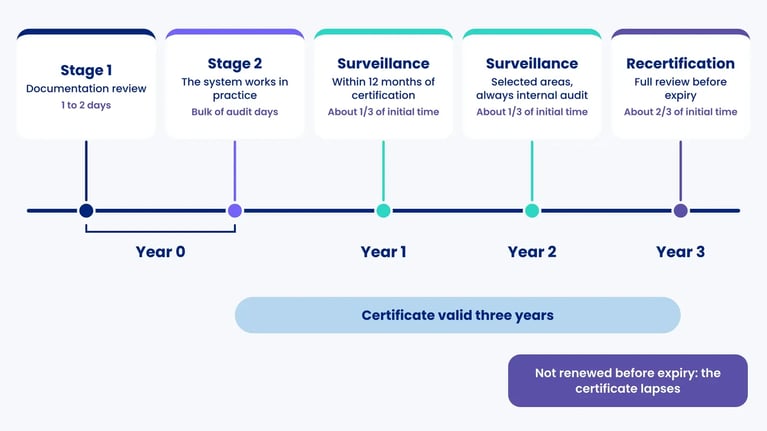
| Year 0 | Stage 1 | Reviews the documentation: scope, policy, risk assessment, SoA, internal audit and management review. Decides whether you are ready for Stage 2 | Typically 1 to 2 days, often partly remote |
| Year 0 | Stage 2 | Checks that the system works in practice: interviews, sampling of controls, logs and evidence. Nonconformities must be closed before the certificate is issued | The bulk of the audit days |
| Years 1 and 2 | Surveillance audit | Checks selected areas, always including internal audit, management review, nonconformities, complaints and changes. The first surveillance falls within 12 months of the certification decision | Around one third of the initial audit time per year |
| Year 3 | Recertification | Full review of the whole ISMS before the certificate expires. New certificate for three years | Around two thirds of the initial audit time |
The number of audit days is set by the number of people working within the scope. ISO/IEC 27006-1:2024 clarified that this includes everyone working for the organisation within scope, whether employees or not, so contractors and freelancers count, and that the number of sites is no longer a separate factor. The same revision removed the earlier 30 per cent ceiling on remote auditing, so a larger share of an audit can now take place over video.
If the certificate is not renewed before it expires, it lapses. There is no extension, and in a tender an expired certificate is the same as no certificate.
What does ISO 27001 certification cost?
Cost is the part most articles skip or quote in a single headline number. Here are the figures we can stand behind, split into the four items that actually make up the bill. Certification has no fixed price list, so these are UK and European market figures, and we say where each one comes from.
| Item | Initial certification | Ongoing (years 1 to 3) | Source and date |
|---|---|---|---|
| Certification body | GBP 3,500 to 26,000 for Stage 1 and Stage 2 combined depending on headcount. Around EUR 5,250 to 10,500 for organisations up to 25 people | Surveillance around one third and recertification around two thirds of the initial audit time | Tempo Audits, UK (July 2026). instant27001, Netherlands (2026) |
| External consultancy | The largest variable. Total first-time programmes in the UK are quoted at GBP 5,000 to 50,000 all in, of which consultancy is the main driver | Optional. Many organisations only buy an externally run internal audit | High Table, UK (2026) |
| Internal time | 0.5 to 1 full-time equivalent for 6 to 18 months | Typically 0.2 to 0.5 full-time equivalent to run the system | .legal, experience figures 2026 |
| Standard and tooling | The standard is bought from ISO or a national body. A compliance platform is usually a subscription | Subscription per year | ISO store. Vendor pricing |
The single factor that moves the audit fee most is the number of people in scope. ISO/IEC 27006-1 contains an indicative audit time table that certification bodies use as a starting point and may adjust up or down for complexity. As one UK accredited body reproduces it in 2026: 1 to 10 people gives 5 audit days, 26 to 45 gives 8.5, 46 to 65 gives 10, 86 to 125 gives 12, 176 to 275 gives 14 and 426 to 625 gives 16.5. The same body publishes a day rate of GBP 1,250. Halve the number of people in scope and the audit days fall noticeably, and the saving repeats in every year of the cycle.
Two notes on the table. The certification body is rarely the largest item, internal time and consultancy are. And the ongoing cost is real: the certificate has to be maintained with an internal audit, a management review and a risk assessment every year, or it falls at the next surveillance.
A worked example: scope, audit days and three years of cost
Harbourline Analytics Ltd and Priya Nair are fictional. We invented them for this article, and they are neither customers nor a case study.
Harbourline Analytics is a UK software company with 120 staff, headquartered in Leeds, that runs an analytics platform for energy utilities in the UK, the Netherlands and Germany. Two of its largest customers are essential entities under NIS2 and have written ISO 27001 into their supplier requirements, with a deadline at contract renewal in 2027. Priya Nair is head of engineering and has been handed the task.
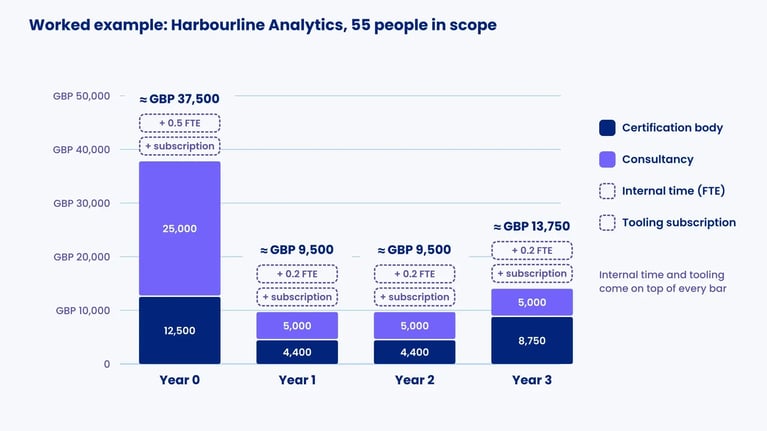
Her first decision is scope. If she certifies the whole company, all 120 people are in scope and the indicative table gives 12 audit days for the initial certification. If she limits the scope to "the development, hosting and support of the Harbourline analytics platform and the IT infrastructure that underpins it", the 55 people in engineering, support, IT and leadership who work within that scope give 10 days. Sales, marketing and finance stay outside, because they do not touch customer data in the platform.
She chooses the narrow scope and checks it against what the customers require. Both buy the platform and the support around it, not Harbourline's payroll system, so the scope matches what they are actually worried about. She writes that into the scope statement so it appears on the certificate.
Her three-year budget looks like this. Certification body at the published day rate of GBP 1,250: 10 days for Stage 1 and Stage 2, so GBP 12,500, then around 3.5 days for each surveillance audit, roughly GBP 4,400 each, and around 7 days for recertification, roughly GBP 8,750, in total about GBP 30,000 over three years. External consultancy for the gap analysis and the internal audit: GBP 25,000 in year one, which sits inside the GBP 5,000 to 50,000 band quoted above, then GBP 5,000 a year for an externally run internal audit. Internal time: half a full-time role for 12 months, then a fifth. A platform for the ISMS on an annual subscription. Year one lands at around GBP 37,500 plus internal time, and each of the following two years at around GBP 9,500 plus subscription and internal time.
Had Priya chosen the whole company as scope, audit days would have risen by 20 per cent, but the larger bill would have been awareness training, access management and physical controls for 65 people who contribute nothing to what the customers are asking for. The point of the example is that scope is the most important financial decision in the whole programme, and it should be made on the basis of who is asking for the evidence and what they are buying.
ISO 27001 and the law: GDPR, NIS2, DORA and the UK
No European or UK law requires private companies to hold ISO 27001 certification. Even so, the standard is the most common way to structure the security work those laws demand, and it pays to be precise about where the line runs.
| Framework | What it requires | What ISO 27001 covers | What the certificate does not do |
|---|---|---|---|
| GDPR Article 32 and UK GDPR | Appropriate technical and organisational measures based on risk, with pseudonymisation, encryption, confidentiality, integrity, availability, resilience, restoration and regular testing given as examples | A risk-based method and controls for access, cryptography, backup, logging and testing. Article 32(3) names approved certification mechanisms as one element for demonstrating compliance | Not an Article 42 scheme. Does not cover lawful basis, data subject rights, the record of processing (Article 30) or processor contracts (Article 28) |
| NIS2 Directive, Article 21(2) | Ten minimum measures for essential and important entities: risk analysis policies, incident handling, business continuity, supply chain security, secure acquisition and development, effectiveness assessment, cyber hygiene and training, cryptography, HR security and access control, MFA and secure communications | All ten areas have matching Annex A controls and clause 6, 7 and 9 requirements. Article 25 explicitly encourages the use of European and international standards | Not registration with the competent authority, not the 24-hour, 72-hour and one-month incident reporting in Article 23, not management approval and training duties in Article 20 |
| DORA, Articles 5 to 16 | ICT risk management framework for financial entities, applicable since 17 January 2025 | Management system, risk assessment, continuity and third-party management | Not DORA's incident reporting, resilience testing or register of ICT third-party providers |
| UK NIS Regulations 2018 and the Cyber Security and Resilience Bill | Security duties and incident reporting for operators of essential services and digital service providers. The Bill, which extends scope to managed service providers and tightens reporting, was at report stage in the House of Lords on 16 September 2026 and had not yet received Royal Assent | The NCSC Cyber Assessment Framework maps closely to an ISO 27001 ISMS, and regulators accept it as supporting evidence | Not a substitute for registration, CAF self-assessment where a regulator requires it, or statutory incident reporting |
The pattern is the same throughout. The laws require you to manage risk and have controls in place, and ISO 27001 is the most proven way to do that. The laws also require regulator contact, deadlines, registers and individual rights, and the standard does not cover those. Our comparison of NIS2 and ISO 27001 goes through the NIS2 requirements one by one, and our guide to GDPR compliance covers that side.
ISO 27001 or something else? ISAE 3000, ISAE 3402, SOC 2, Cyber Essentials and ISO 27701
Customers do not always ask for ISO 27001. Some ask for an assurance report, some for a badge, and the difference is not cosmetic.
| Evidence | Type | Issued by | Validity | Typically used when |
|---|---|---|---|---|
| ISO 27001 | Certification of a management system | Accredited certification body | 3 years with annual surveillance | International tenders, supplier requirements, NIS2 backbone |
| ISAE 3000 and ISAE 3402 | Auditor's assurance report on controls over a period (type 2) or at a point in time (type 1) | Registered auditor | Usually covers 12 months, renewed annually | Processors reporting to controllers (3000), outsourced financial processes (3402) |
| SOC 2 | US assurance report against the AICPA Trust Services Criteria | CPA firm | Report period, usually 12 months | US customers and SaaS sales into the US |
| Cyber Essentials and Cyber Essentials Plus | UK government-backed scheme covering five technical control areas, run by the NCSC through IASME | IASME certification bodies | 12 months | UK public sector contracts, small suppliers, a baseline rather than a management system |
| ISO/IEC 27701:2025 | Privacy information management system (PIMS). Since 14 October 2025 a standalone standard, no longer only an extension of 27001 | Certification body, transition rules still being set by accreditation bodies | 3 years | Organisations that want to evidence GDPR work on top of security work |
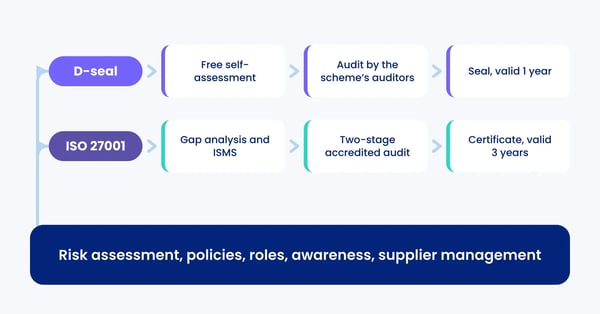
The most important distinction is between certification and assurance. ISO 27001 certifies the system going forward, while an ISAE 3000 report or ISAE 3402 report documents that specific controls operated over a specific period. Many European processors hold both, because customers ask for ISO 27001 in the tender and for ISAE 3000 in the annual audit. The controls can largely be reused if they are documented in one place. For Danish readers, our comparison of the D-seal and ISO 27001 covers the Danish national label as well.
Who needs ISO 27001 certification, and who can settle for compliance?
Go for certification when someone outside the organisation needs to trust your security without auditing you themselves. That is the case when customers or tenders name the standard, when you supply NIS2-covered entities that must manage their supply chain under Article 21(2)(d), when you sell software or hosting across borders, or when you want an external discipline that keeps the ISMS alive year after year.
Settle for compliance, meaning conformity without a certificate, when the evidence is only needed internally, when a regulator expects you to follow the standard but does not require certification, or when you are building the ISMS as your NIS2 framework and intend to certify only when customers ask. The work is the same. What you save is the audit fee and the external discipline. What you lose is the proof.
A middle path many organisations take is to build to the standard from day one and have an external party run the clause 9.2 internal audit. You are then ready for Stage 1 the day a tender demands it, without having paid for the certificate in the years before.
How .legal supports your ISO 27001 compliance
The hard part of ISO 27001 is not writing the documents once. It is keeping the cycle running every year so that the risk assessment, the SoA, the internal audit and the management review are current when the auditor arrives. That is what .legal is built for.
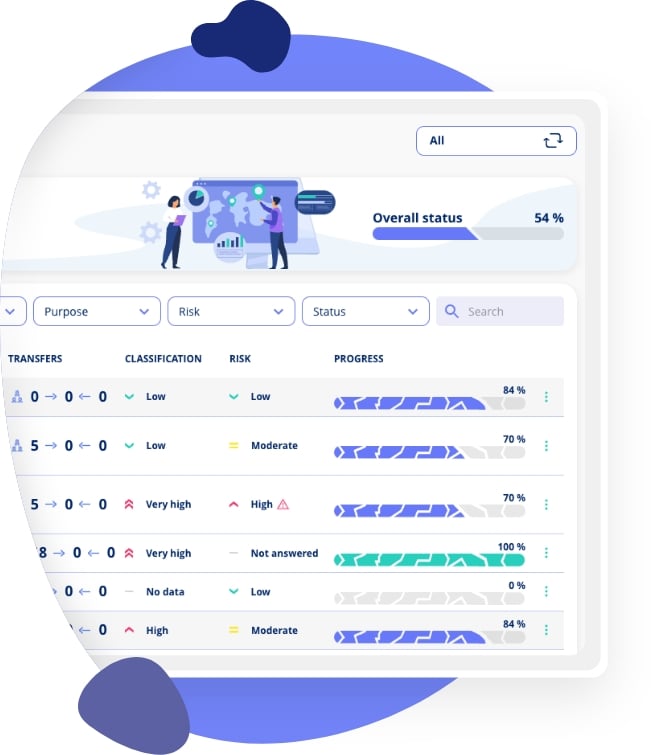
In our information security management module you work directly in the ISO/IEC 27001:2022 structure: you document scope, policies and roles, run risk assessments with one shared method, and take a position on all 93 Annex A controls in a Statement of Applicability with justifications and implementation status. Policy management handles versioning and staff sign-off for clause 7.5, and the Frameworks module maps the same controls to NIS2 Article 21, GDPR Article 32 and ISAE 3000, so one documented control counts in every framework it satisfies. Compliance task management keeps internal audits, management reviews and risk reviews on the calendar with owners and deadlines, and the full history is ready as an audit trail for Stage 1, Stage 2 and surveillance audits.
The platform does not perform the audit and it does not make you certified. It makes sure the work you put into the ISMS is documented, reusable and easy to find when it has to be shown. Book a demo and see the ISO 27001 framework in the platform.












.legal compliance platform
Achieve ISO 27001 with .legal
-
Map and track all Annex A controls
-
Manage risk assessments and treatment plans
-
Document policies and procedures
-
Prepare for certification audits
-
Monitor continuous compliance





.jpeg?width=131&height=26&name=right_people_logo%20(1).jpeg)

.jpg?width=58&height=26&name=Praktiserende%20L%C3%A6gers%20Organisation%20(1).jpg)
.jpg?width=108&height=26&name=finans%20danmark%20(1).jpg)


.jpg?width=89&height=26&name=klasselotteri%20(1).jpg)

-1.png?width=34&height=26&name=bws_shipping_rgb%20-%20Kopi%20(2)-1.png)



.jpeg?width=135&height=26&name=AH%20industries%20(1).jpeg)






.jpg?width=225&height=26&name=KAUFMANN%20(1).jpg)