
What is Contract Management? A Complete Guide
Contract management is about more than filing signed agreements. Learn what CLM is, what poor contract management actually costs, and what a good system needs to do.


Contracts get scattered across shared drives, email threads, and folders nobody can find. Nobody knows exactly which agreements expire when, or what they actually commit the organisation to. This is the reality in many businesses, and the consequences are far more expensive than most people realise.
According to World Commerce & Contracting, organisations lose an average of 8.6% of total contract value through poor contract management. For a business with contracts totalling £10 million, that is £860,000 disappearing each year, largely unnoticed.
This guide covers what contract management is, the phases every contract moves through, what poor contract management actually costs, and what a good system needs to do. We also cover something most contract management articles miss entirely: the European compliance obligations that make good contract management a legal requirement, not just good practice.
What is Contract Management?
Contract management is the process of managing legally binding agreements from initial negotiation through to conclusion or renewal.
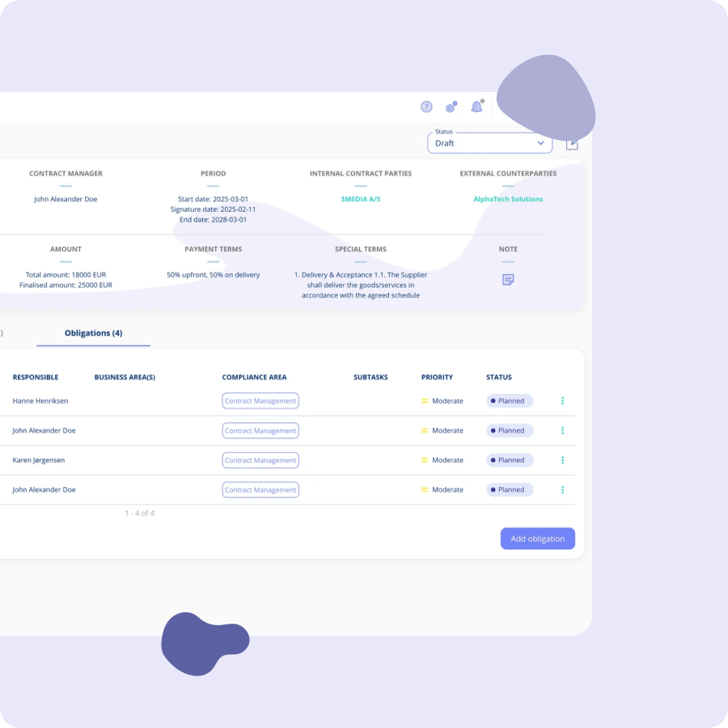
It is about more than having a signed contract in a folder. Good contract management covers everything that happens after signature: monitoring obligations, tracking deliverables, ensuring terms are adhered to, and acting in time when agreements approach expiry.
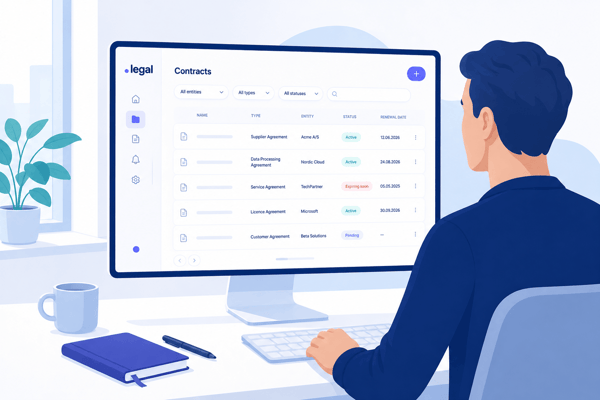
Contract Lifecycle Management (CLM) describes the structured approach to managing contracts through their entire lifecycle, from initial scoping through to archiving. A CLM system is the digital foundation that makes it possible to centralise, search, and monitor all agreements in one place.
The difference between having contracts and managing them is precisely the difference between being in control of your organisation and hoping things work out.
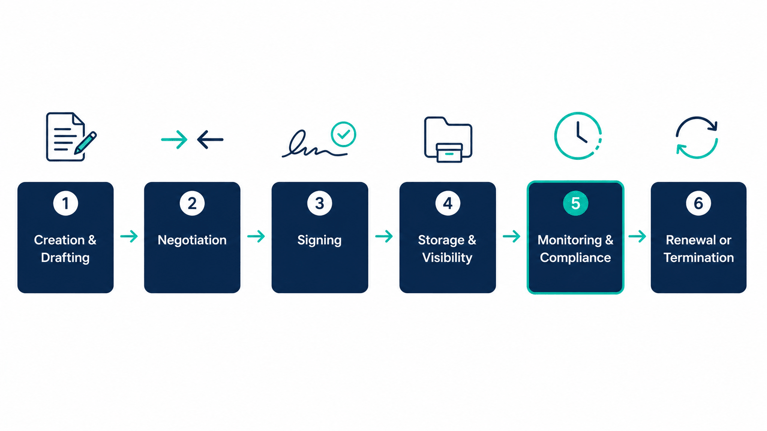
The Contract Lifecycle — 6 Phases
A contract lifecycle typically moves through six phases. The hallmark of good contract management is working actively across all six, not just at the point of signature.
1. Creation and drafting
This is where the need for an agreement arises. Templates and standard clauses save time and ensure critical elements are not missed from the outset. Approval workflows ensure the right people are involved before anything goes to the counterparty.
2. Negotiation
Contracts typically pass through several versions before both parties agree. Version control and a clear change log ensure it is always clear what was agreed, when, and by whom. That clarity avoids a great deal of dispute down the line.
3. Signing
Digital signatures have made the execution process considerably faster and more traceable than physical signing. This is also precisely the point where the contract’s effective date and term need to be registered correctly in the system, so reminders for renewal and follow-up can be set automatically.
4. Storage and visibility
A central repository with metadata and full-text search is the foundation for everything else. Without it, contracts end up in folders nobody can locate, and the only person who knows where a particular agreement lives is the one person currently on annual leave.
5. Monitoring and compliance
This is the phase most organisations underestimate. Who is delivering what, and by when? Are SLAs being met? Are obligations actually being fulfilled?
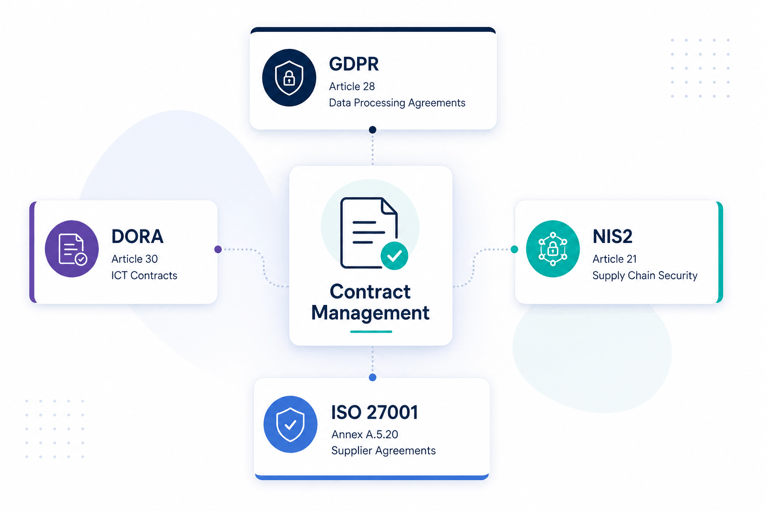
The compliance dimension is particularly important here. GDPR Article 28 requires data processing agreements to be actively maintained and reviewed, not merely signed. NIS2 Article 21 requires that supplier security is documented contractually and monitored on an ongoing basis.
6. Renewal or termination
A proactive assessment of whether a contract should be renewed, terminated, or renegotiated requires notifications well in advance of the deadline. Automatic reminders make a real difference here. A contract that auto-renews on unfavourable terms because nobody acted in time is one of the most common, and most avoidable, contract management failures.
| Phase | Key tasks | Compliance relevance |
|---|---|---|
| 1. Creation | Templates, approval workflows | GDPR Art. 28 DPA content requirements |
| 2. Negotiation | Version control, change log | Documentation of agreed terms |
| 3. Signing | Digital signature, effective date | Audit trail of agreement execution |
| 4. Storage | Central repository, searchability | GDPR documentation obligations |
| 5. Monitoring | Obligation tracking, KPIs | NIS2 Art. 21, GDPR Art. 28, DORA |
| 6. Renewal/termination | Reminders, renegotiation | Updating regulatory requirements |
What Does Poor Contract Management Cost?
The direct costs of poor contract management fall into three categories, each pulling in the same direction.
Financial leakage
According to World Commerce & Contracting, organisations lose an average of 8.6% of total contract value through poor contract management. The sources are varied: automatic renewals on unfavourable terms, missed volume discounts, undetected billing errors, and services paid for but not used. Multiplied across a large contract portfolio, this represents a substantial, largely invisible financial drain.
Operational risk
Insufficient monitoring of supplier obligations creates quiet risks that grow over time. SLAs may not be met. Service levels slip. And because nobody is watching, issues are discovered late, usually at the point of a service failure or a dispute.
Compliance exposure
For European organisations, the compliance consequences are concrete. A data processing agreement that fails to meet GDPR Article 28 can trigger fines of up to €10 million or 2% of global annual turnover. NIS2 creates obligations around supplier contracts, and non-compliance can result in personal liability for management. ISO 27001 Annex A.5.20 addresses information security in supplier agreements specifically, and DORA obligates financial entities to document contractual requirements for all ICT service providers.
Contract Management and Compliance — What Most Articles Miss
Most articles on contract management stop at the lifecycle and perhaps a software recommendation. For organisations operating in the EU, however, the regulatory picture is inseparable from good contract management. This is precisely where a compliance-focused approach adds the most value.
GDPR: data processing agreements are contracts
All data processing agreements are contracts, and they need more than a signature. They must be maintained, reviewed, and updated as supplier relationships evolve and legislation changes. GDPR Article 28 sets out eight specific requirements for DPA content, and non-compliance exposes both controllers and processors to fines. Compliance with a DPA is not a one-time check. It is an ongoing obligation.
NIS2: supplier contracts as compliance documentation
Organisations in scope under NIS2 must address supplier security contractually. NIS2 Article 21 requires that organisations include cybersecurity standards, incident notification obligations, audit rights, subcontractor requirements, and business continuity provisions in supplier contracts. Those contracts are, in practice, the documentary evidence of compliance with the regulation.
ISO 27001: structured contract management supports certification
Annex A.5.20 in ISO 27001:2022 specifically addresses information security in supplier agreements. A contract management system that supports documentation and ongoing monitoring of supplier obligations directly strengthens the certification evidence base. See our guide to NIS2 vs ISO 27001 for a complete mapping of the two frameworks.
DORA: financial entities and ICT contracts
Financial entities subject to DORA (fully applicable from January 2025) must document contractual requirements for all ICT service providers under DORA Article 30. Having the agreements somewhere is not sufficient. They must be registered, accessible, and reportable to competent authorities annually.
What Should a Contract Management System Do?
A contract management system is not about scale or budget. It is about what the system actually enables. These are the capabilities that make a practical difference:
- Central repository with full-text search: All content in one place, searchable and accessible to the right people.
- Automatic reminders: For expiry dates, obligation deadlines, and renewal windows — so nothing is missed because someone forgot to update a calendar entry.
- Templates and approval workflows: Consistent structure from the outset, ensuring contracts are created correctly and approved by the right stakeholders.
- Digital signature: Faster, more traceable, and far easier to manage than physical signing processes.
- Access controls and audit trail: Who viewed what, when. Who changed what, and when. This is not just good practice — it is a requirement under GDPR and NIS2.
- Integration with vendor management and compliance modules: Contracts and compliance are connected. A system that handles storage but does not link contracts to supplier compliance status solves only half the problem.
.legal’s contract management software brings contracts, obligation tracking, and vendor management together in one place, with direct integration to the GDPR module and NIS2 frameworks. So compliance and contract management do not live in separate silos. Read more about what good contract compliance requires in practice.
How to Get Started with Contract Management
Getting started does not require a large project. Three concrete steps are enough to establish meaningful control — for a complete walkthrough, see our step-by-step guide.
1. Take stock of your existing contracts
Where are they? Who owns them? When do they expire? Many organisations discover during this step that contracts they had almost forgotten about are either approaching expiry or have already auto-renewed on terms nobody assessed.
2. Prioritise contracts with compliance relevance
Data processing agreements, supplier contracts involving NIS2-scoped vendors, and ICT service contracts under DORA should be prioritised. This is where the risk is highest and the value of having proper oversight is most immediate.
3. Choose a system that matches your maturity level
Start simple. The most important first step is getting all contracts into one place with reminders on expiry and key obligations. Everything else can be built on top of that foundation. Want to see what it looks like in practice? Book a demo and get a walkthrough of .legal’s contract management capabilities.








.legal compliance platform
Manage Your Contracts with .legal
-
Central repository with full-text search
-
Automatic reminders for expiry and obligations
-
Templates for diferent contract types
-
Audit trail for each contract
-
Direct integration with GDPR and NIS2 modules





.jpeg?width=131&height=26&name=right_people_logo%20(1).jpeg)

.jpg?width=58&height=26&name=Praktiserende%20L%C3%A6gers%20Organisation%20(1).jpg)
.jpg?width=108&height=26&name=finans%20danmark%20(1).jpg)


.jpg?width=89&height=26&name=klasselotteri%20(1).jpg)

-1.png?width=34&height=26&name=bws_shipping_rgb%20-%20Kopi%20(2)-1.png)



.jpeg?width=135&height=26&name=AH%20industries%20(1).jpeg)






.jpg?width=225&height=26&name=KAUFMANN%20(1).jpg)




