What is Contract Compliance? A Practical Guide
Contract compliance means ensuring every party to an agreement delivers on what was promised, from performance deadlines to GDPR data processing obligations. This guide covers the definition, scope, risks, responsibilities, and best practices.

Most organisations don't lose contracts. They lose track of what those contracts actually require, and when. A renewal date slips by unnoticed. An obligation buried in clause 7.4 goes unactioned because nobody was assigned to it. A supplier misses an SLA that nobody was monitoring.
That's contract compliance failure in practice. And it's far more common than most organisations want to admit. According to research from World Commerce & Contracting, organisations lose an average of 8.6% of total contract value through poor contract management. In a European regulatory environment that now embeds legal requirements directly into contracts, from GDPR data processing agreements to NIS2 supply chain obligations, the stakes are higher than ever.
This guide covers what contract compliance is, what it involves, who is responsible, the risks of getting it wrong, and the best practices for managing it effectively.
What is Contract Compliance?
Contract compliance is the ongoing process of ensuring that all parties to a contractual agreement fulfil the terms, conditions, and obligations set out in the contract, as well as any applicable laws, regulations, and internal policies.
It covers both directions. Your organisation must deliver on its own obligations: deadlines, deliverables, payment terms, data handling commitments. And the other party must do the same. This is the distinction between internal compliance (your performance) and external compliance (your counterparty's performance).
Contract compliance doesn't end at signature. It's a continuous discipline that runs for the entire life of the agreement. Many organisations treat contracts as a one-time event: negotiate, sign, file. The actual work of contract compliance begins after the ink is dry.
What Does Contract Compliance Cover?
Contract compliance spans four core areas, each with its own operational demands.
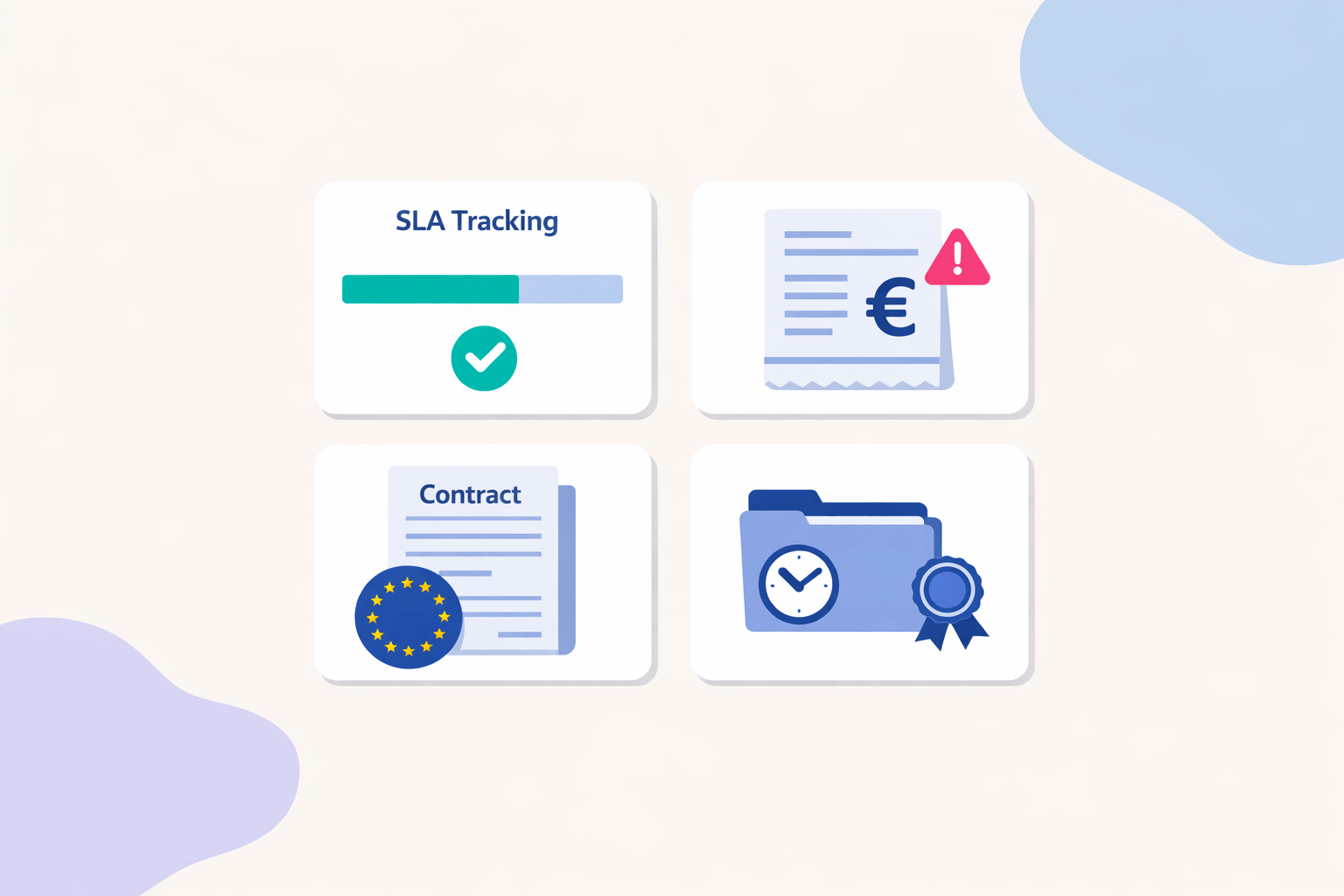
Performance tracking
Are SLAs being met? Are deliverables arriving on time and to specification? Are milestones being hit? Without active monitoring, performance gaps accumulate silently, until they become disputes. Performance tracking means having a system for measuring delivery against the commitments captured in the contract, not just a general sense of whether the relationship feels healthy.
Financial integrity
Contracts contain specific pricing structures, discount entitlements, escalation clauses, and payment schedules. Without systematic tracking, invoices get overpaid, volume discounts go unclaimed, and billing errors go undetected. KPMG research puts invoice and credit errors alone at 2–10% of deal value in poorly managed contracts. Multiplied across a large supplier portfolio, that's a material financial exposure.
Regulatory adherence
This is where European organisations face obligations that US-centric contract management literature rarely covers. Contracts with suppliers who process personal data must comply with GDPR Article 28. Contracts with ICT service providers in financial services must meet DORA Article 30. Contracts with vendors covered by NIS2 must address supply chain security. The EU AI Act creates contractual obligations between AI system providers and deployers. These aren't optional extras. They're legal requirements embedded in your contractual relationships. We cover this in detail below.
Documentation and audit trails
Who agreed to what, when, and in what form? Change orders, amendments, approvals, correspondence. All of it needs to be retained and retrievable. When disputes arise or regulatory audits happen, documentation is the difference between a straightforward resolution and a prolonged one. Under GDPR, NIS2, and DORA, audit rights and documentation obligations are legally mandated, not just good practice.
Who is Responsible for Contract Compliance?
The honest answer is: it depends. And that's precisely the problem.
In practice, responsibility is distributed across Legal (who draft and review), Procurement (who manage vendor relationships), Finance (who track invoices and payments), Operations (who monitor delivery), and Contract Managers or administrators (who coordinate across all of them). Internal Audit gets involved periodically. Executives are ultimately accountable. Every one of those teams has a legitimate stake.
Without a clear governance structure, specifically a RACI model that assigns Responsible, Accountable, Consulted, and Informed roles per contract or contract category, obligations fall through the gaps. A survey by SC&H Group found that 42% of procurement teams report having no clear structure for contract oversight. Not no person. No structure.
The challenge isn't that no one is responsible for contract compliance. It's that everyone is, a little. Without a clear system, obligations fall through the gaps.
The Risks of Poor Contract Compliance
Poor contract compliance creates four categories of risk that compound over time.
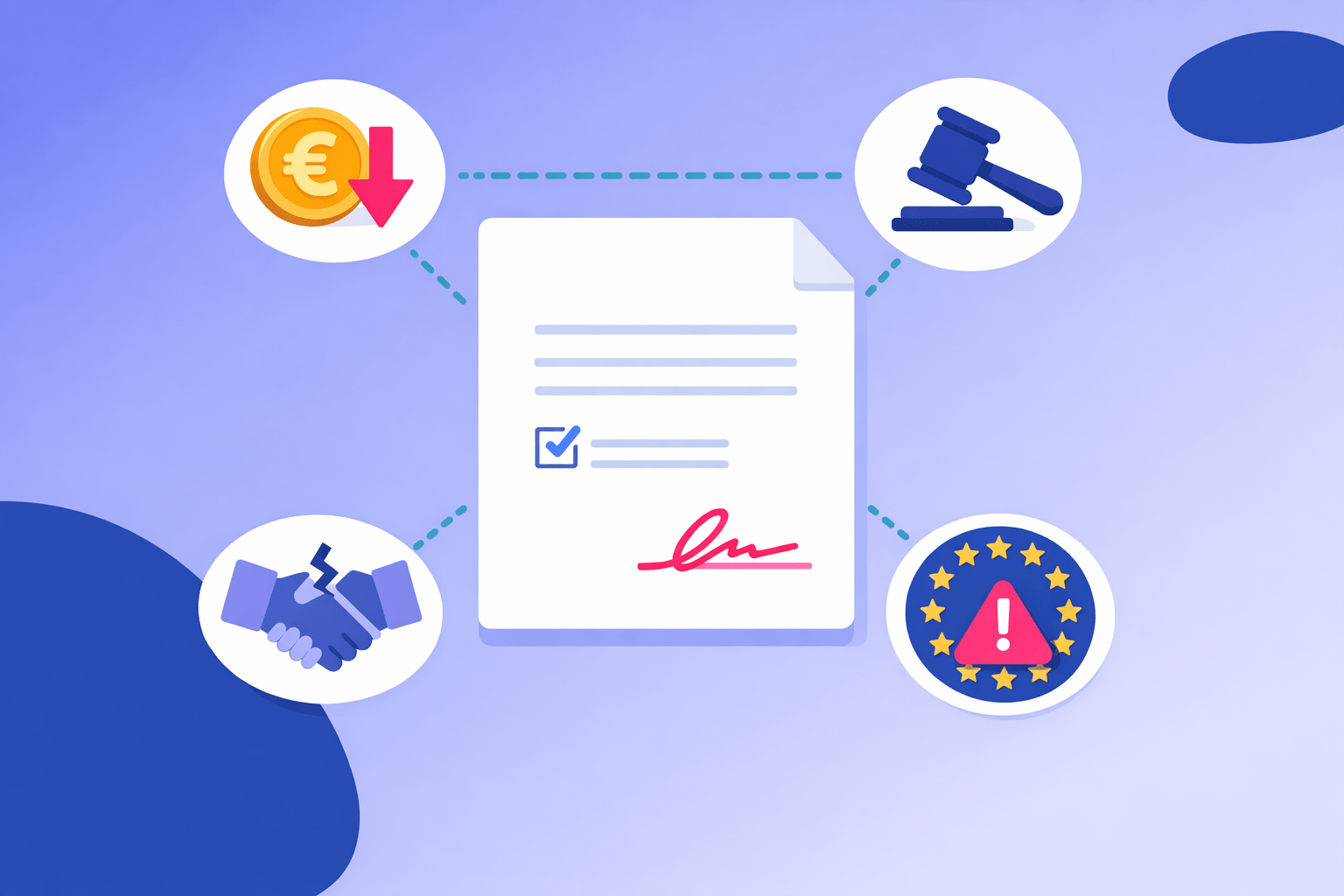
Financial leakage is the most immediate. World Commerce & Contracting research shows that poorly managed contracts erode an average of 8.6% of total contract value. The sources are numerous: missed volume discounts, undetected overcharging, unclaimed credits, scope creep, and billing errors. In an organisation with hundreds of active contracts, this figure represents a significant and largely invisible financial drain.
Legal exposure follows closely. A party that fails to meet its contractual obligations risks breach of contract claims, litigation, and financial penalties. This applies both ways. Your organisation can be held liable for non-performance, and you need the documentation to enforce non-performance by others. Without a systematic approach to contract management, the evidence needed to defend or pursue a claim is often scattered or missing.
Reputational damage is harder to quantify but real. Suppliers who miss SLAs, clients who don't receive what they paid for, and partners who discover post-audit that obligations were quietly ignored. These are relationship-ending failures. They go beyond the financial, and they take considerably longer to recover from.
Regulatory penalties are particularly acute for European organisations. A data processing agreement that doesn't meet GDPR Article 28 requirements exposes both controller and processor to fines of up to €10 million or 2% of worldwide annual turnover. The French data protection authority CNIL fined Dedalus Biologie €1.5 million specifically because the processor's contractual documentation didn't meet Article 28(3) obligations. GDPR enforcement has resulted in cumulative fines exceeding €5.88 billion across Europe. NIS2 adds personal liability for management on top of organisational sanctions.
Contract Compliance Best Practices
Managing contract compliance effectively requires more than good intentions. It requires systems, ownership, and a consistent process.
Centralise your contract repository
A single, searchable location for every contract. Not email attachments, not shared drives, not someone's local folder. A 2024 WorldCC survey found that 61% of organisations lack complete visibility into their contract portfolio. You cannot manage what you cannot find. Centralisation is the precondition for everything else.
Extract and assign obligations
A contract sitting in a repository is only half the work. Every obligation (deliver by, pay by, report by, review by) needs to be extracted, assigned to a named owner, and tracked. The Contract Obligations add-on in .legal does exactly this, turning contracts into actionable task lists with named owners and deadlines. An obligation without an owner is a ticking clock.
Automate notifications and deadlines
Renewal dates, SLA review points, regulatory reporting deadlines. None of these should depend on a single person's calendar or memory. Automated alerts create a system of record that survives personnel changes and busy periods. This is particularly important for regulatory obligations under GDPR and NIS2, where missed deadlines carry financial and legal consequences.
Conduct regular compliance reviews
Not just at renewal. Quarterly or biannual reviews for high-value contracts identify performance gaps and billing discrepancies before they become disputes. The earlier a problem is caught, the cheaper it is to resolve. Periodic reviews also ensure that contracts remain aligned with current regulatory requirements, important given the pace of EU legislation.
Integrate vendor compliance
Your suppliers' performance is part of your compliance picture. This is especially true under NIS2, where a supplier's security posture directly affects your regulatory exposure, and under GDPR, where you remain responsible for ensuring data processors adhere to their Article 28 obligations. Vendor management and contract compliance are two sides of the same coin.
Maintain an audit trail
Document who approved what, when, and in what context. This protects your organisation in disputes and satisfies regulators during audits. Under DORA, NIS2, and GDPR, audit rights and documentation obligations are legally mandated. Having an automatic, tamper-evident audit trail is increasingly a regulatory requirement, not just an operational nicety.
Contract Compliance and EU Regulation
This is where the European context makes contract compliance genuinely different, and genuinely more complex, than the picture painted by most contract management literature. European organisations don't just need to monitor whether parties are performing. They need to ensure that the contracts themselves reflect legal obligations, and that those obligations are being monitored on an ongoing basis.
GDPR: data processing agreements
GDPR Article 28 mandates a written Data Processing Agreement (DPA) for every controller-processor relationship. The DPA must contain eight specific provisions: documented processing instructions, confidentiality commitments, security measures aligned with Article 32, sub-processor authorisation, assistance with data subject rights, assistance with breach notification and DPIAs, data deletion or return obligations, and audit rights. Both controllers and processors can be fined for absent or non-compliant DPAs, up to €10 million or 2% of global turnover under Article 83(4). Compliance with a DPA isn't a one-time check. It's an ongoing obligation to verify that processors are adhering to the terms in practice.
NIS2: supply chain security obligations
NIS2 (Directive 2022/2555) requires in-scope organisations to address supply chain security in vendor contracts. Article 21(2)(d) covers security-related aspects of relationships with direct suppliers and service providers. The EU Commission's implementing regulation, applicable to digital entities since October 2024, specifies contractual provisions including cybersecurity standards, incident notification obligations, audit rights, sub-contractor requirements, and business continuity planning. Essential entities face fines up to €10 million or 2% of global turnover, with personal liability for management under Article 20. Read more in our guide to NIS2 vs ISO 27001.
EU AI Act: provider-deployer obligations
The AI Act creates a shared-responsibility model for the AI value chain. Providers must supply deployers with technical documentation, instructions for use, and information sufficient for GDPR DPIAs. Article 25 establishes contractual responsibilities between providers and deployers of high-risk AI systems. For organisations procuring AI tools, this means contracts with AI vendors now carry compliance obligations, and must be monitored accordingly. Main obligations for high-risk AI apply from August 2026.
DORA: ICT service contracts in financial services
DORA (Regulation 2022/2554), fully applicable since January 2025, mandates detailed contractual provisions for all ICT service contracts in the financial sector under Article 30. These cover service descriptions, data protection, availability targets, incident assistance, audit rights, and exit strategies. Financial entities remain fully responsible for DORA compliance even when using third parties, and must maintain a comprehensive register of all contractual arrangements reported to competent authorities annually.
For European compliance teams, contract compliance isn't just about whether parties are performing. It's about ensuring the agreements themselves are legally sound, and that they're being monitored for ongoing adherence.
How Contract Compliance Software Helps
Managing contract compliance at scale, across dozens or hundreds of active agreements, with regulatory obligations that differ by contract type, isn't a spreadsheet problem. It's a systems problem.
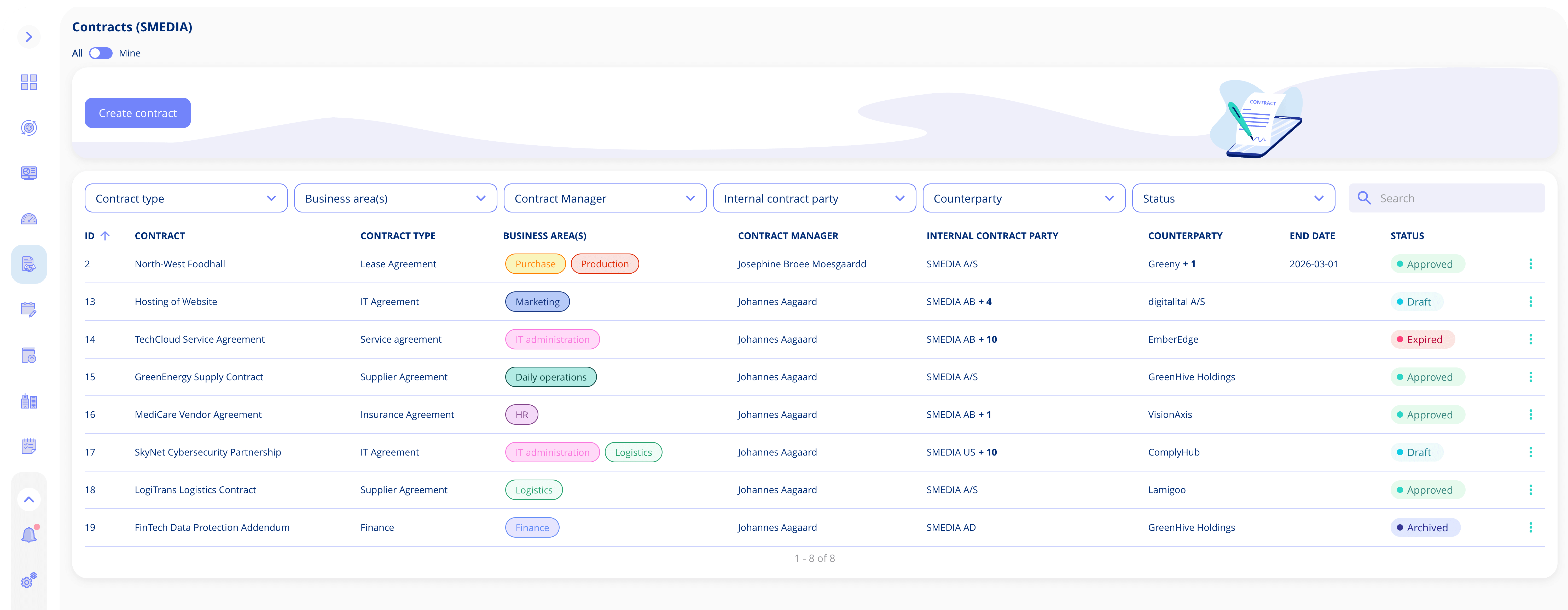
See the platform in action in our On-demand video demo here.
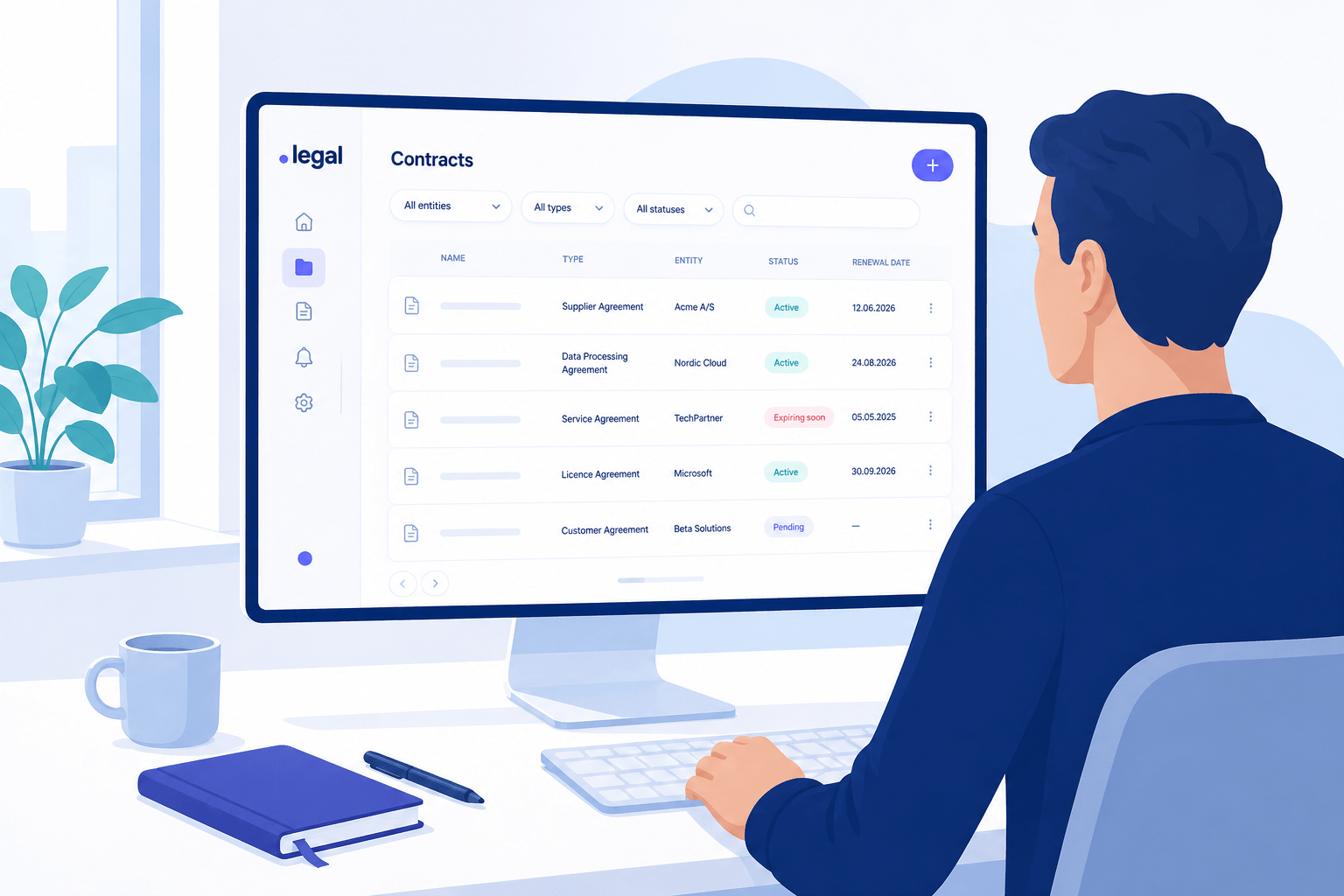
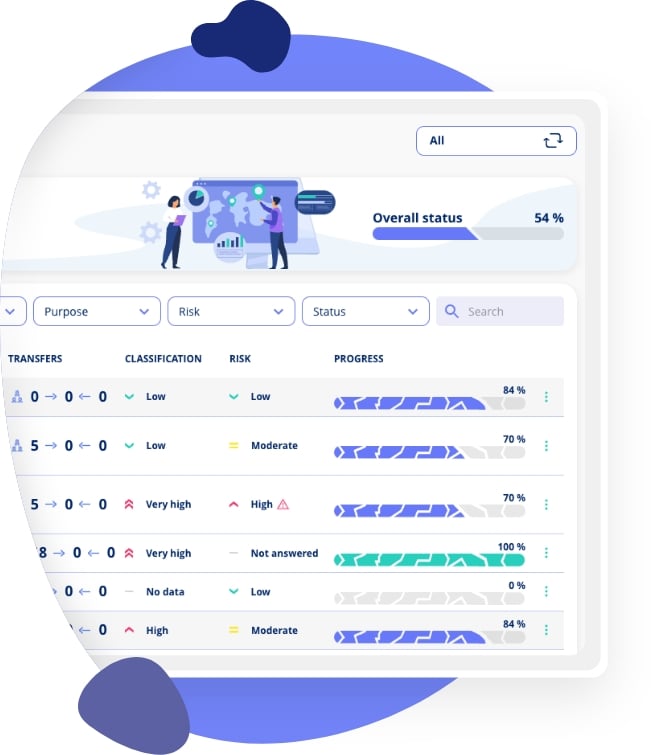
Contract compliance software solves this by centralising all contracts in a single repository with full search and version history. Obligation tracking tools extract and assign individual obligations to named owners, with automated notifications for deadlines and review points. Compliance dashboards give a real-time view of which contracts are on track and which need attention. Audit trails record every action taken against a contract, providing the documentation needed for disputes and regulatory audits.
The vendor management integration is particularly valuable in a European regulatory context. When NIS2 requires you to monitor supplier security compliance, or GDPR requires you to verify that data processors are adhering to their DPA obligations, you need more than contract storage. You need an active compliance programme that connects contracts to vendor performance and regulatory obligations.
Platforms like .legal's contract management software bring contract management, obligation tracking, and vendor management together in one place, so nothing falls between the teams responsible for each. You can track whether a supplier is meeting their contractual and regulatory obligations from the same system, with a full audit trail of every review, approval, and escalation. Book a demo to see how it works in practice. For a practical roadmap, see how to implement contract management.










.legal compliance platform
Take Control of Your Contract Obligations
-
Centralise all contracts with full search and version history
-
Extract and assign obligations with automated deadline alerts
-
Monitor supplier compliance against GDPR and NIS2 requirements
-
Track SLA performance and billing accuracy in real time
-
Maintain audit trails for regulatory inspections and disputes





.jpeg?width=131&height=26&name=right_people_logo%20(1).jpeg)

.jpg?width=58&height=26&name=Praktiserende%20L%C3%A6gers%20Organisation%20(1).jpg)
.jpg?width=108&height=26&name=finans%20danmark%20(1).jpg)


.jpg?width=89&height=26&name=klasselotteri%20(1).jpg)

-1.png?width=68&height=52&name=bws_shipping_rgb%20-%20Kopi%20(2)-1.png)



.jpeg?width=135&height=26&name=AH%20industries%20(1).jpeg)






.jpg?width=493&height=57&name=KAUFMANN%20(1).jpg)