
Vendor Contracts: What They Must Contain and How to Manage Them
Most businesses have vendor contracts. Far fewer know what they actually contain. Get the complete checklist and understand the requirements under GDPR, NIS2, and ISO 27001.

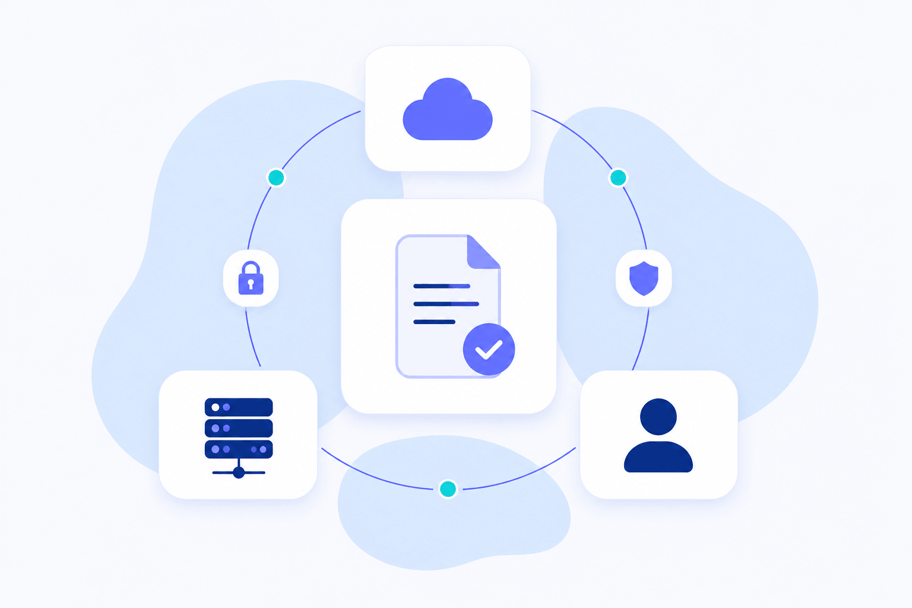
Most businesses have vendor contracts. But in practice, many discover they have no real idea what those contracts contain, when they expire, or whether they meet today’s legal requirements.
That gap has grown alongside the regulatory landscape. GDPR, NIS2, and ISO 27001 all place specific requirements on what a vendor contract must contain and document. Getting it wrong can be costly — and vendor problems tend to surface at the worst possible moment.
This guide gives you the complete picture: what the contract must cover, what the law requires, and how to make sure you actually have it under control.
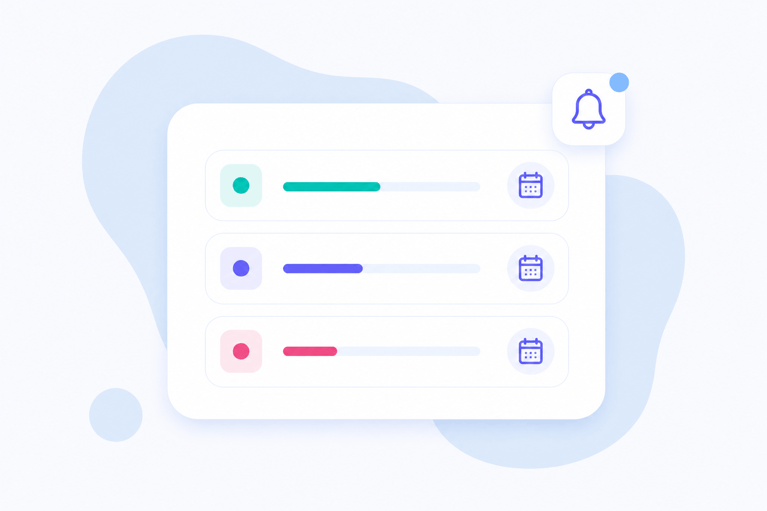
What Is a Vendor Contract?
A vendor contract is a legally binding agreement between a business and an external supplier. It sets out the services, responsibilities, obligations, and terms of the relationship.
It is important to understand what a vendor contract is not: it is not the same as a Data Processing Agreement (DPA). The vendor contract governs the entire business relationship. The DPA is a separate legal requirement under GDPR, specifically regulating the processing of personal data. Both are necessary when the vendor processes personal data on your behalf — and one does not replace the other.
A good vendor contract creates clarity for both parties, documents your security and legal requirements, and gives you the means to act quickly if the relationship breaks down.
What Must a Vendor Contract Contain?
This is the question most people are looking for an answer to. And the answer is not a single clause — it is a checklist that covers the entire relationship from start to finish.
| Element | What it covers |
|---|---|
| Parties and subject matter | Who is the agreement between, and precisely what is being delivered? |
| Scope of services and SLA | Quality requirements, delivery timelines, uptime, and service levels |
| Price, payment, and adjustments | Fees, payment terms, price escalation, and billing model |
| Duration and termination | Contract term, notice periods, and conditions for automatic renewal |
| Liability and limitation | Who bears responsibility, and what is the cap on liability? |
| Confidentiality and non-disclosure | What information is confidential, and for how long? |
| Sub-contractors | Who are approved sub-contractors, and under what conditions? |
| Security requirements | Minimum technical requirements, certifications, and audit rights (NIS2 and ISO 27001-relevant) |
| Data processing | When is a DPA required? Link to GDPR Article 28 obligations |
| Breach and termination for cause | Consequences of contract breach and the right to immediate termination in serious cases |
| Exit strategy and data handling | What happens to data and systems when the contract ends? |
| Governing law and jurisdiction | Which law applies, and which court handles disputes? |
That is a long list. Deliberately so. A vendor contract that only covers the first four items is not a proper vendor contract — it is an offer with a signature.
Vendor Contracts and GDPR
There is one misunderstanding we encounter repeatedly: that a Data Processing Agreement replaces the vendor contract. It does not.
The two documents serve different purposes. The vendor contract governs the entire business relationship — services, pricing, liability, and termination. The Data Processing Agreement specifically governs the processing of personal data under GDPR Article 28. Both documents are required when your vendor processes personal data on your behalf.
GDPR also requires you to carry out oversight of your data processors and to ensure that any sub-processors are approved and bound by equivalent obligations. This is an area many organisations overlook — and it can create problems in the event of a data breach.
A practical rule of thumb: if your vendor has access to personal data for which you are the controller, a DPA is required alongside the vendor contract. The two agreements are linked, but they are separate documents with distinct purposes.
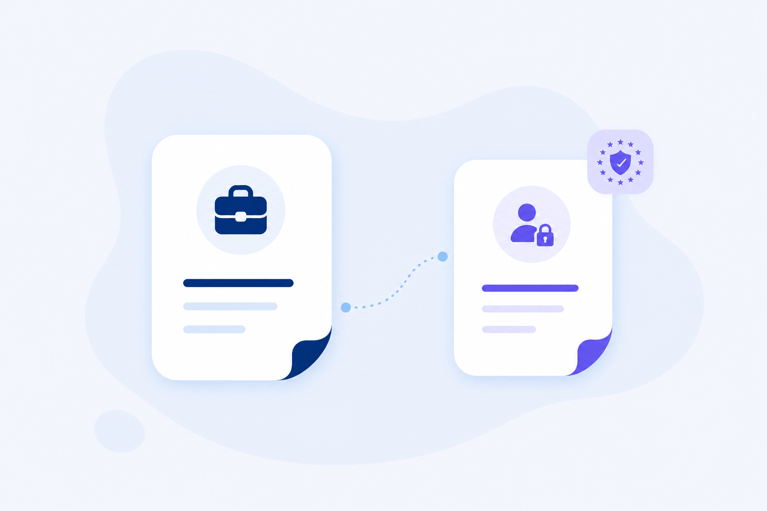
Vendor Contracts and NIS2
This is where .legal’s approach differs from most. NIS2 is not only relevant for organisations directly in scope — it affects the entire supply chain.
NIS2, implemented in Danish law on 1 July 2025, sets explicit supply chain security requirements under Article 21(2)(d). Organisations within the in-scope sectors must actively manage security across their supply chains. And that happens primarily through contracts.
In practice, the vendor contract must include:
- Specific security requirements — not vague references to "reasonable security", but concrete, enforceable technical minimum requirements
- Audit rights — agreed in advance, so you actually have the right to carry out oversight
- Incident response obligations — the vendor must notify you within agreed timeframes when a security incident occurs
- Exit strategy and data handling — documented in the contract, not agreed verbally at the point of termination
A practical example: an organisation in the energy sector uses a cloud provider for business-critical systems. Under NIS2, it is not sufficient to know the provider takes security seriously. It must be in the contract — which standards are maintained, how incidents are reported, and what happens if the relationship ends.
Organisations not directly in scope can still be affected: if you supply services to a NIS2-covered customer, expect them to pass security requirements down to you contractually. That is the cascade effect built into NIS2’s supply chain logic.
Read more about NIS2 and what it requires of your organisation.
Vendor Contracts and ISO 27001
ISO 27001:2022 addresses supplier security directly through two controls:
- Annex A.5.19 — Information security in supplier relationships: requires a policy for supplier security and ensures that security requirements are agreed with suppliers, including conditions for access to information assets
- Annex A.5.20 — Information security within supplier agreements: requires security requirements to be documented in the supplier agreements themselves, covering confidentiality, incident notification, access control, audit rights, and exit terms
For organisations that are certified or working towards ISO 27001 certification, vendor contracts form part of the audit evidence reviewed during certification assessments. Having an internal security policy is not enough — it must be reflected in the contracts you hold with your vendors.
Financial organisations under DORA (the Digital Operational Resilience Act) face equivalent obligations under Article 30, which sets specific contractual requirements for ICT service providers — including exit strategies, inspection rights, and reporting obligations.
Read more about ISO 27001 compliance and what it requires in practice.
Vendor Risk Management — From Contract to Ongoing Oversight
The contract is the starting point, not the finish line. A solid vendor contract creates the framework — but managing vendor risk is an ongoing process.
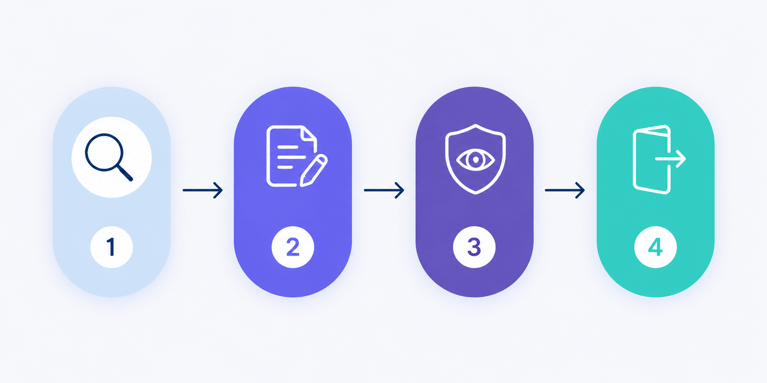
A structured approach looks like this:
- Assessment — Due diligence before signing: what is the vendor’s security maturity? Do they hold relevant certifications? What is the impact if they fail?
- Contract — Agree security requirements, audit rights, incident response, and exit terms in writing and without ambiguity
- Oversight — Ongoing follow-up through audits, status reviews, and incident log monitoring
- Renegotiation or exit — Contracts are renegotiated when requirements change, or when the vendor fails to meet agreed standards
Want a deeper walkthrough? Our step-by-step guide shows how to implement contract management end-to-end. It sounds straightforward. But for organisations managing 20, 50, or 200 active vendor contracts, it is a genuine governance challenge to track expiry dates, verify that security requirements are still current, and document oversight for regulators.
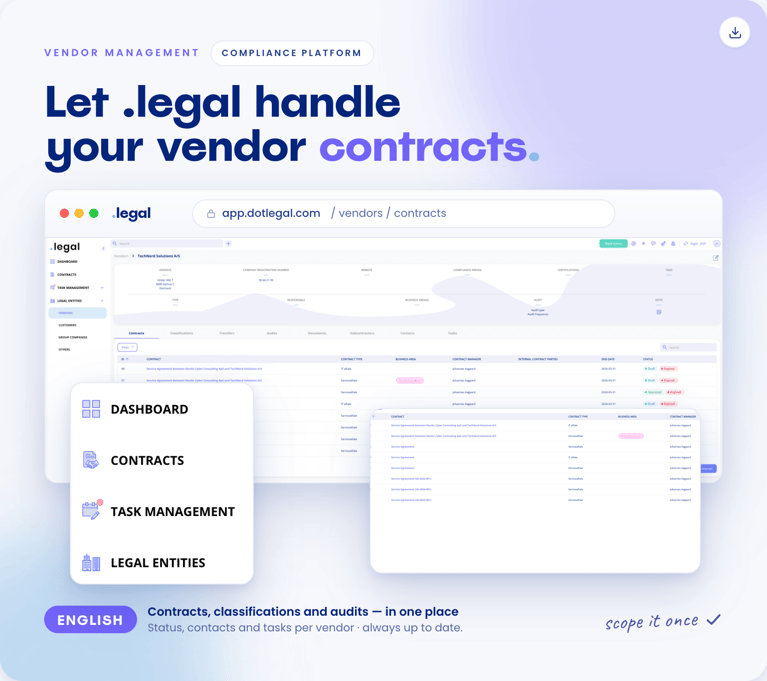
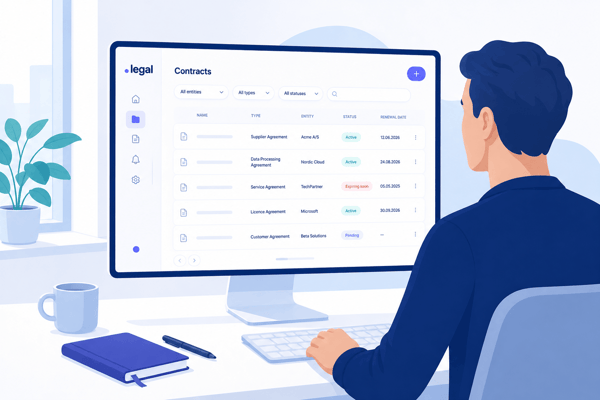
That is exactly what .legal’s vendor management module addresses: a central view of all vendor relationships, with linked contracts, DPAs, audit logs, and automatic reminders for renewal and follow-up.
Read more about information security risk management and vendor audits.
Common Mistakes in Vendor Contracts
These mistakes are more common than you might expect. And most are only discovered when something goes wrong.
- Automatic renewal without a reminder mechanism — The contract renews quietly, and no one notices that the terms are outdated
- No termination right in the event of a security breach — The vendor suffers a serious data breach, but the contract provides no clear right to immediate termination
- DPA missing or out of date — The vendor processes personal data, but no DPA was ever created — or it dates from 2018
- Sub-contractors not specified or approved — The vendor uses sub-contractors you are not aware of and have not approved
- No exit plan at contract end — The relationship ends, but no one agreed what happens to data, systems, and access credentials
- Security requirements too vague to be enforceable — The contract mentions "reasonable security measures", but that is too ambiguous to act on
How to Manage Many Vendor Contracts
For organisations with a significant number of vendor relationships, ad hoc management is not sustainable. What is needed is a structured system.
A good setup includes:
- Central contract repository — All vendor contracts in one place, not scattered across drives, inboxes, and local folders
- Automatic renewal reminders — Notifications well in advance of expiry or automatic renewal
- DPAs linked to vendor profiles — The Data Processing Agreement is directly connected to the vendor and contract, not stored separately
- Audit log — Documentation of when vendor reviews were carried out and what was followed up on
.legal’s contract management software is built for precisely that: oversight, reminders, and integration with the compliance process. Want to see how it works in practice? Book a free demo and get a clear picture of what is missing in your vendor management.






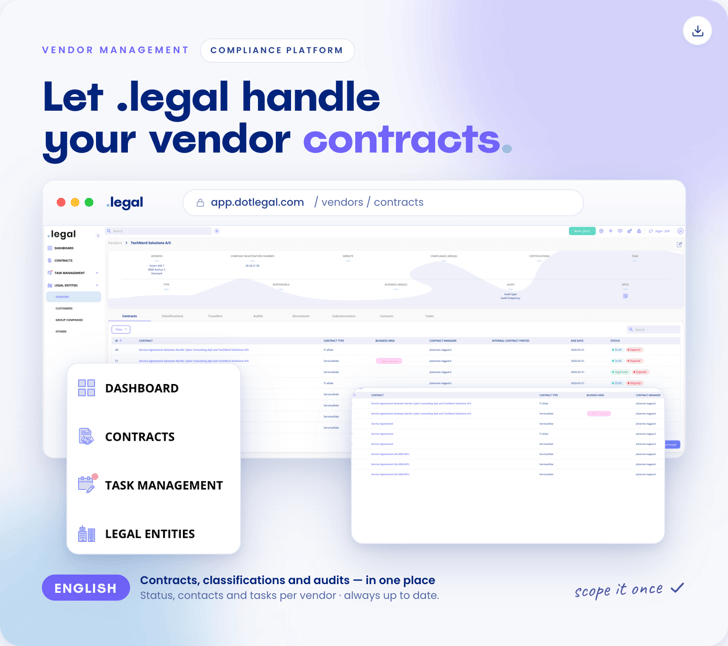
.legal compliance platform
Manage Your Vendor Contracts with .legal
-
Central repository for all vendor contracts and DPAs
-
Automatic renewal and expiry reminders
-
Audit log for vendor reviews and follow-up
-
Security requirements aligned with NIS2 and ISO 27001
-
Integrated with GDPR and NIS2 modules





.jpeg?width=131&height=26&name=right_people_logo%20(1).jpeg)

.jpg?width=58&height=26&name=Praktiserende%20L%C3%A6gers%20Organisation%20(1).jpg)
.jpg?width=108&height=26&name=finans%20danmark%20(1).jpg)


.jpg?width=89&height=26&name=klasselotteri%20(1).jpg)

-1.png?width=34&height=26&name=bws_shipping_rgb%20-%20Kopi%20(2)-1.png)



.jpeg?width=135&height=26&name=AH%20industries%20(1).jpeg)






.jpg?width=225&height=26&name=KAUFMANN%20(1).jpg)




