
NIS2 guide: requirements, deadlines and who is covered
Who NIS2 covers, what it requires and which deadlines apply, including the Danish NIS2 Act, which has applied since 1 July 2025.

Last updated: 15 November 2026
NIS2 is the EU directive (2022/2555) on cybersecurity for medium-sized and large organisations in 18 critical sectors, such as energy, transport, health, digital infrastructure and public administration. It requires risk management measures, incident reporting within 24 hours, management accountability and supply chain security. In Denmark, the NIS2 Act has applied to private and public entities since 1 July 2025.
This guide covers who is covered, the requirements area by area, deadlines and fines, how NIS2 works in Denmark, how it relates to GDPR and ISO 27001, and how to get started.
Who is covered by NIS2?
Two things decide whether an organisation is covered: its sector and its size.
- Sector. Annex I of the directive lists the sectors of high criticality: energy, transport, banking, financial market infrastructure, health, drinking water, waste water, digital infrastructure, ICT service management (business-to-business), public administration and space. Annex II lists other critical sectors: postal and courier services, waste management, chemicals, food, manufacturing (such as medical devices, electronics, machinery and vehicles), digital providers and research.
- Size. As a rule, NIS2 covers medium-sized and large organisations: at least 50 employees, or an annual turnover and balance sheet total above EUR 10 million.
Some entities are covered regardless of size, for example providers of public electronic communications networks, trust service providers, DNS service providers and top-level domain name registries. The authorities can also designate an entity that is critical to society.
Essential and important entities
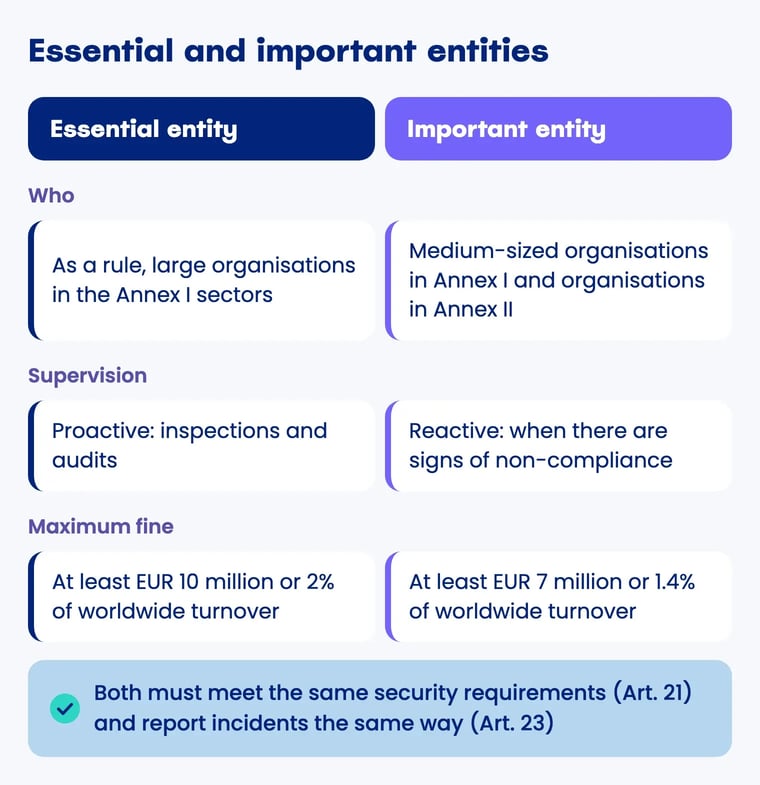
Covered organisations are either an essential entity or an important entity. As a rule, large organisations in the Annex I sectors are essential. Medium-sized organisations in Annex I and organisations in Annex II are important. Both must meet the same security requirements. The difference lies in how they are supervised and how high the fines can be.
Suppliers are not covered just because they deliver to a covered entity. They feel NIS2 through their customers' supply chain requirements, unless they fall within a sector themselves, as managed IT service providers do.
Each organisation must assess its own status. In Denmark, Styrelsen for Samfundssikkerhed (SAMSIK) publishes guidance on the scope of the NIS2 Act, and that is the place to start if you are unsure.
NIS2 requirements area by area
Article 21 of the directive sets out ten minimum security measures. They are risk-based: the measures must be appropriate and proportionate to the risks the organisation faces. In practice, the requirements fall into five areas.
Risk management (Article 21)
You need policies for risk analysis and information system security, and measures that follow from them: access control, asset management, cryptography, vulnerability handling, secure development and maintenance, and multi-factor authentication where appropriate. You must also assess whether the measures work. Our guide to NIS2 risk assessment shows how to do it step by step.
Incident reporting (Article 23)
A significant incident must be reported in three steps: an early warning within 24 hours of becoming aware of it, an incident notification within 72 hours, and a final report within one month. Read more about incident reporting under NIS2. In Denmark, incidents are reported via virk.dk.
Supply chain security
You must address security in your relationships with direct suppliers and service providers, including the vulnerabilities specific to each supplier and the quality of their security practices. Our guide to managing vendor risk under NIS2 shows how to classify suppliers and follow up on them.
Management accountability and training (Article 20)
The management body must approve the security measures, oversee their implementation and can be held liable for breaches. Members of the management body must follow training, and organisations should offer similar training to employees regularly. See management accountability and the NIS2 training requirements.
Business continuity
You must be able to keep operating and recover after an incident: backup management, disaster recovery and crisis management are part of the minimum measures.
NIS2 deadlines and fines
NIS2 is not on its way. It applies now.
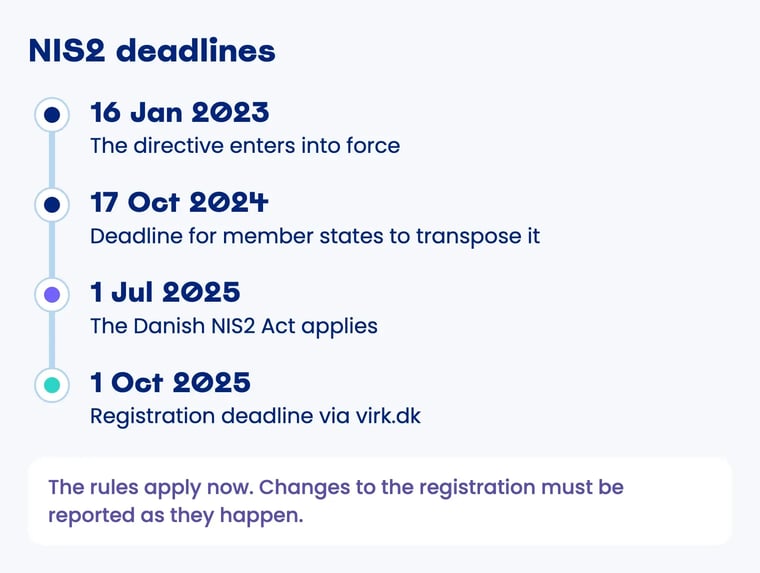
- 16 January 2023: the directive entered into force.
- 17 October 2024: the deadline for member states to transpose it. The rules apply from 18 October 2024.
- 1 July 2025: the Danish NIS2 Act entered into force.
- 1 October 2025: the deadline for entities covered from the start to register with the Danish authorities via virk.dk. Changes must be reported afterwards.
The directive sets the maximum fine at no less than EUR 10 million or 2% of total worldwide annual turnover, whichever is higher, for essential entities, and no less than EUR 7 million or 1.4% for important entities. Read more about sanctions under NIS2. For essential entities, the authorities can also temporarily prohibit a manager from exercising managerial functions. The Danish Act does not state the size of a fine; it is decided case by case.
Essential entities are subject to proactive supervision, with inspections and audits. Important entities are supervised reactively, when there are signs that they do not comply.
NIS2 in Denmark
Denmark has implemented the directive through the NIS2 Act (Act no. 434 of 6 May 2025 on measures to ensure a high level of cybersecurity). It has applied since 1 July 2025 and is supplemented by executive orders. Our guide to NIS2 in Denmark explains how the Act, the executive orders and the sector rules fit together.
- Registration and reporting go through virk.dk.
- Supervision is shared between sector authorities, each responsible for its own sectors, while SAMSIK coordinates and publishes the cross-sector guidance.
- Energy and telecoms have their own sector rules alongside the NIS2 Act.
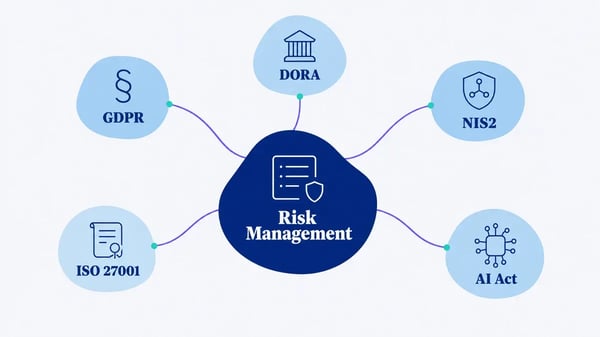
- Financial entities are covered by DORA. The NIS2 Act does not apply where sector-specific EU rules have at least the same effect. Our guide to NIS2, DORA and CER explains which rule applies when.
NIS2, GDPR and ISO 27001
GDPR protects personal data. NIS2 protects network and information systems and the services that depend on them. One incident can trigger both: a personal data breach must be notified to the data protection authority within 72 hours, while a significant incident follows the NIS2 steps of 24 hours, 72 hours and one month.
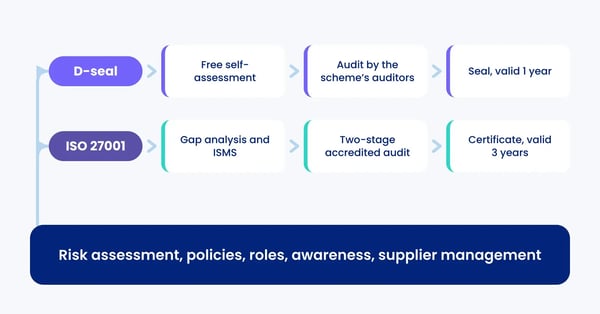
Is ISO 27001 enough for NIS2? Not on its own. NIS2 does not require certification, and there is no certification under NIS2 for an organisation. An ISMS built on ISO 27001 covers much of Article 21. NIS2 adds registration, the reporting deadlines, management accountability and training for the management body. In Denmark, only state authorities are required to follow the ISO 27001 framework. Read NIS2 and ISO 27001 compared for the full mapping.
| Topic | NIS2 | GDPR | ISO 27001 |
|---|---|---|---|
| Protects | Network and information systems and services | Personal data | All information in the ISMS scope |
| Binding | Law for covered entities | Law for everyone processing personal data | Voluntary standard |
| Incidents | 24 hours, 72 hours, 1 month | 72 hours to the authority | A defined process, no deadline |
| Management | Approves, oversees, trains, can be held liable | Controller is accountable | Top management commitment (clause 5) |
| Fines | Essential: at least EUR 10m / 2%. Important: at least EUR 7m / 1.4% | Up to EUR 20m / 4% | None |
How to get started with NIS2
- Clarify whether you are covered using SAMSIK's guidance on scope, and register if you are.
- Run a gap analysis against Article 21 and any Danish sector rules that apply to you.
- Assess your risks and make a plan with an owner for each measure.
- Set up incident handling and train management, so the 24-hour, 72-hour and one-month steps work in practice.
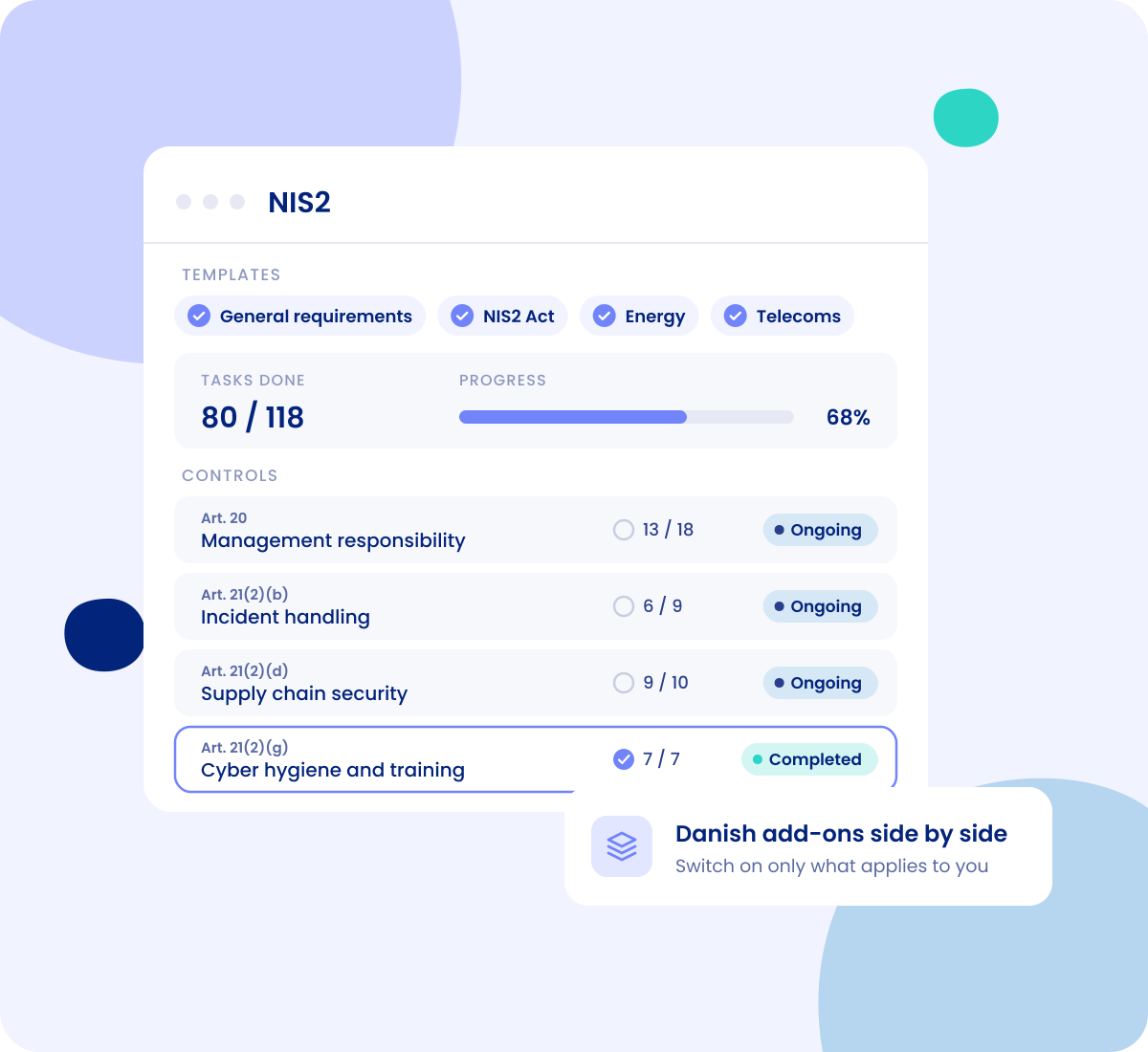
Our 12-step implementation guide takes you through the work in detail and comes with a free checklist. If you want to document the work on a platform, .legal has NIS2 templates for the directive and the Danish add-ons (the NIS2 Act, energy and telecoms), which you can switch on side by side: see NIS2 compliance software.
Sources: the NIS2 text and Danish guidance
- Directive (EU) 2022/2555 (NIS2) on EUR-Lex: the full text in all EU languages, also as PDF.
- The Danish NIS2 Act on retsinformation.dk (in Danish).
- SAMSIK's NIS2 guidance on scope, registration and reporting (in Danish).






.legal compliance platform
See how .legal covers the NIS2 requirements
-
Switch on the base package and the Danish add-ons side by side
-
Work with controls that map 1:1 to the source text
-
Risk-assess critical assets with NIS2 scenarios
-
Register NIS2 incidents and when they were reported
-
Follow progress per control and per framework