Skip to content

Put a number on the risk, and on what it costs to fix

When more mitigation work lands on your desk than there is budget for, the order has to come from arithmetic: what a risk would cost you if it happened, where that figure lands once a plan is done, and what the plan itself costs. You supply the estimates. The platform holds them together and keeps the reasoning attached.

Unlimited users  •  Free onboarding and support  •  No commitment

Illustration of a tall block and a much shorter block on one platform, joined by an arc, while a figure beside a fan of plan cards lifts one of them towards the blocks
+400 companies use .legal
Region Sjælland
Aarhus Universitet
aj_vaccines_logo
Realdania
Right People
IO Gates
PLO
Finans Danmark
geia-food
Evida
Klasselotteriet
NRGI1
BLUE WATER SHIPPING
Karnov
Ingvard Christensen
VP Securities
AH Industries
Lægeforeningen
InMobile
AK Nygart
DEIF
DMJX
Axel logo
qUINT Logo
KAUFMANN (1)
SMILfonden-logo
kurhotel_skodsborg
nemlig.com
Molecule Consultancy
Novicell
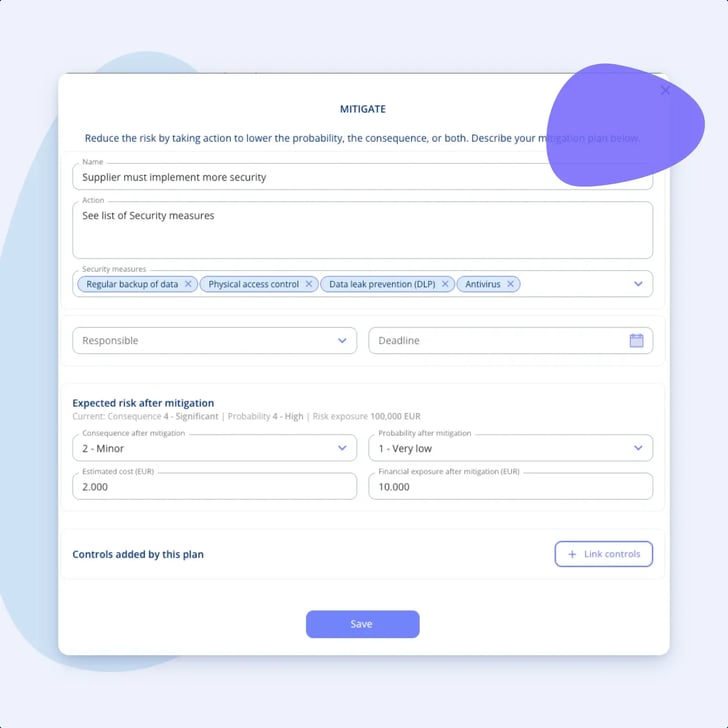
A mitigation plan in .legal with its security measures, the consequence and probability expected after mitigation, and the plan's estimated cost next to the financial exposure expected afterwards

Risk exposure and mitigation cost

Meridian's security spend now gets decided on the arithmetic

Every autumn Anders Krogh goes into Meridian Nordic's budget round with more mitigation work in front of him than there is budget for. He is the group's security lead, he answers for risk across three countries, and the case he could make used to be a list of risk levels and a request. Two risks sitting at the same level told nobody which one to deal with first. Now each assessment can carry what the risk is estimated to cost if it happens, each plan says what it will cost and where the exposure is expected to land afterwards, and Anders arrives with a difference and a price per plan.

  • Exposure before, exposure after, and the cost of getting from one to the other, all on objects that already exist.
  • Five competing plans go into an order, because there is finally something comparable to sort them by.
  • The risk level expected on completion is written down before anything is committed, not reported once it has been.
  • The case that won the budget is the same case that travels upwards, so it is not rebuilt for the meeting.

  • Compare plans, not levels

    Two risks at the same level say nothing about which to fix first. The three figures behind each plan do.

  • The reduction is the point

    Exposure now, and where it lands once the work is done. The difference between the two is what you are actually buying.

  • Stated before the spend

    A plan carries its estimated cost and the risk level expected on completion, so what the work is meant to achieve is on the record first.

  • Your estimates, your arithmetic

    Every figure is one you put in. No benchmark, no industry table, no model. The platform adds them up and stores the reasoning.

Illustration of a small tray overflowing with plan cards beneath a row of identical, unmarked tiles, with a figure holding a card some way off and an empty tray outline on the ground

Risk exposure and mitigation cost

More work than budget, and nothing to rank it on

The register does its job. Anders can see what sits above appetite and what does not. The awkward part starts one step later, when he has to choose which of those things gets dealt with this year.

  • A risk level compares to another risk level and stops there. It tells you about severity, not about what fixing it is worth.
  • The colleague holding the budget does not think in levels, so the case gets rebuilt in a different language every time it is made.
  • The cheapest fix and the most useful fix are rarely the same fix, and nothing on a matrix says which is which.
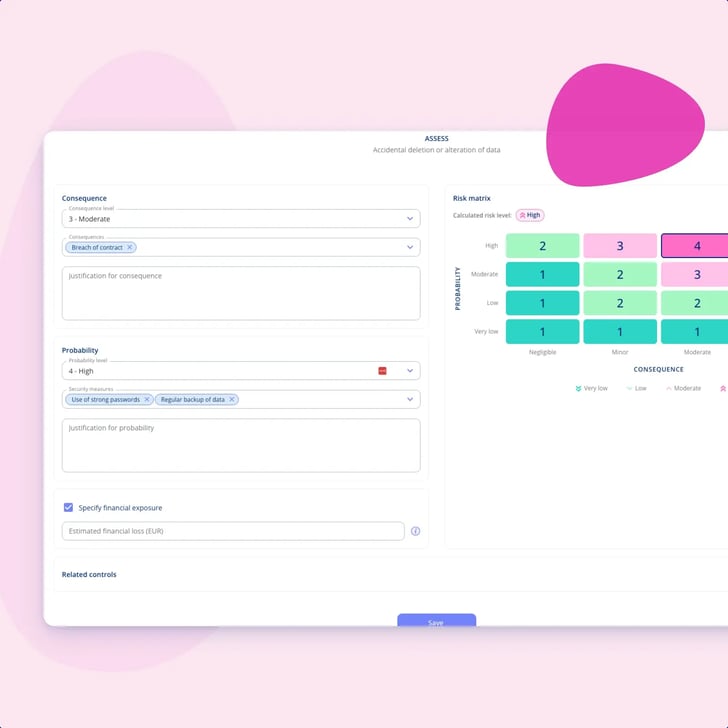
The assessment of one risk scenario in .legal, with consequence and probability levels, a justification field for each, the security measures, the risk matrix and the field for estimated financial loss

Risk exposure and mitigation cost

The loss estimate belongs on the assessment

The first of the three figures sits where the risk is assessed rather than in a separate financial exercise. Whoever states the consequence level and the probability level can put a figure on the loss at the same time.

  • It is your estimate of what the risk would cost if it happened, filed next to the justification that consequence and probability each require anyway.
  • It is optional. A risk area can run on its levels alone, and plenty will, which is a legitimate way to work rather than a half-finished setup.
  • Estimate to compare, not to audit. What the decision uses is the order of magnitude and the direction, and being consistent across your entities matters far more than being exact on any one of them.
Illustration of a tall violet block and a short pale blue block on one base, with a measuring bracket spanning the difference in height between them

Risk exposure and mitigation cost

The difference is the number worth arguing from

The other two figures live on the mitigation plan, and the useful one is the distance between them. Exposure now, exposure once the work is done, and the gap that separates the two.

  • The plan says where the exposure is expected to land afterwards, so the reduction is on the record instead of being asserted in a meeting.
  • It also says what the work is expected to cost, which turns a plan into something with two sides rather than a request with one.
  • And it carries the risk level expected on completion, so the effect is stated in the same terms the register already runs on.
Illustration of five plan cards standing on a descending staircase of pads, each card with three bars in different lengths, while a figure holds up one more card to find its place

Risk exposure and mitigation cost

Five plans, one order

This is the part of the job that has no honest answer without figures. Line up the three numbers behind each open plan and the plans stop competing on who asked most persistently.

  • A large reduction for a modest cost is easy to defend, and a modest reduction for a large cost is easy to defer. The interesting plans are the ones in between, and they are the ones that used to be invisible.
  • Nothing is ranked for you. The platform puts the figures next to each other, keeps them attached to the assessment they came from, and leaves the ordering to a person.
  • Because the reasoning is stored with the numbers, next year's round starts from what you decided last year rather than from what anyone remembers.
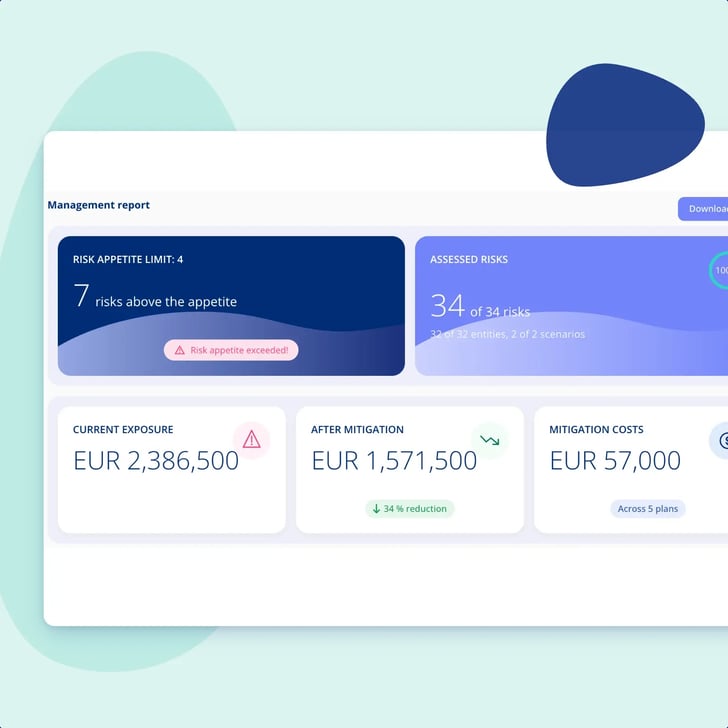
The management report in .legal, with risks above appetite and assessed risks at the top and three financial figures below: current exposure, exposure after mitigation and the cost of the mitigation plans

Risk exposure and mitigation cost

The same figures carry upwards

The numbers are entered once, on individual assessments and plans, and they aggregate on their own. Nobody rebuilds the argument in a spreadsheet to answer the question one level up.

  • Exposure and plan cost roll up to risk area level, so an area's totals come out of the entities inside it rather than out of a separate exercise.
  • The management report gathers the same figures across areas, which means management reads the arithmetic you already did rather than a fresh version of it.
  • What that report actually contains, and how it is handed on, is a different job with a page of its own.
Illustration of a figure filling in a slot on an input panel, with an empty outline shelf behind it and a slab in front where two short bars add up to a longer one

Risk exposure and mitigation cost

Every number in here is one of yours

This is the part we put in writing rather than leave for a demo to find. The platform has no idea what an outage would cost Meridian, and it does not pretend to.

  • There is no benchmark, no industry table and no loss model behind the exposure field. Somebody at Meridian estimated it, with a justification attached and a timeline that keeps it.
  • What the platform contributes is the sum and the paper trail. It does not put a price on your risk, and it does not tell you which plan to fund.
  • It documents risk rather than detecting it. Nothing here scans your estate or finds a risk you have not written down. We build the plan, not the filling-in.
.legal in practice

Features for risk exposure and mitigation cost

What the risk would cost you

A loss estimate that goes on the assessment itself, put there by the same colleague who is already weighing how bad it would be and how likely it is. It is not a separate finance exercise bolted on afterwards.

What is left when the work is finished

A plan says where that estimate is expected to sit once the work is finished. It is the half of the argument nobody could produce before, and it is the half a budget owner asks for first.

What the work is priced at

The same plan carries an estimated cost, so both halves sit on one object and neither can be put in front of anybody without the other.

The expected level, before approval

A plan also carries the risk level expected once the actions are complete, so the effect is documented before anything is committed rather than reported after.

The figures add up on their own

The three figures aggregate by risk area and then across areas into the management report, so answering upwards does not mean rebuilding the case in a spreadsheet.

Optional, and it sits beside your scale

Exposure is a field you can leave alone. A risk area can run on its levels only, and where you do use figures they sit alongside the scale rather than replacing it.

.legal compliance platform

Put a number on risk with...

Do you need to put a number on your risks, and on what it costs to fix them? We recommend the following modules for that task.

Information Security Management

Run your information security management and meet NIS2, ISO 27001 and more in one place. The risk work on this page sits beside it.

Explore Information Security Management

Our Customers

+400

companies

+11.000

users

+79.000

contracts

+14.000

processing activities

Mikkel Friis

Bech-Bruun

Mikkel Friis Rossa (Partner)

.legal's team has consistently demonstrated a commitment to innovation while being responsive to the needs of our mutual clients.

Rasmus-boutrup-fenerum

Fenerum

Rasmus Boutrup (Financial Controller)

Case Study
With .legal, we've gained a simpler and more manageable solution that better suits our needs
Michael Berner 1

Lægeforeningen

Michael Berner (Lawyer)

.legal has been the right choice for us. .legal are professional and welcoming with skilled employees.
Nanna Rodian Christensen

Molecule Consultancy

Nanna Rodian Christensen (HR & Operational Manager)

Case Study
Firstly, it means that not all the work is in one place (me), and secondly, that the understanding of GDPR is implemented throughout the organisation.
ulrikdueholmbeckmann

Plum Safety

Ulrik Dueholm Beckmann (QC, CM og ESG Lead)

Case Study
From .legal, we experience an incredibly high degree of flexibility and willingness to adapt features to our local needs.
julie-oxenvad-novicell

Novicell

Julie Oxenvad (Legal Consultant)

Case Study
We are satisfied with the switch to .legal – it has strengthened our compliance work, made processes easier to manage and more transparent, and improved cross-team collaboration
Tinna Schultz

Min By Media

Tinna Schultz (HR Manager)

Case Study
It just works! It is so easy and user-friendly, and the overview of processing activities is brilliant.
ansat_Kaspar_Rochholz_005

DMJX

Kaspar Rochholz (GDPR Coordinator)

Case Study
.legal has really understood what it means to create a user-friendly and efficient solution. Privacy is an attractive product compared to price and functionality.
Profile-picture1

Axel Kaufmann ApS

Julie Lundkvist Andreasen (Lawyer and Head of Costumer Service)

Case Study
.legal continuously update the platform to ensure their customers always remain compliant. In our view, any other choice would be a downgrade.

NRGi

Mette Mühlendorph (Compliance Specialist)

Case Study
The implementation of .legal has made a difference in the way we handle compliance. The system has created structure and overview, which has had concrete benefits.
Use cases

Find the job you need done

Every use case is a real piece of compliance work, told the way it actually runs in the platform. Filter by who you are, what you work with, and which frameworks you answer to.

Book demo

22 use cases

Compliance & GRC lead

Build one risk register for the whole organisation

One register across GDPR, NIS2, AI and information security, where each risk area keeps its own matrix, scale and appetite. Delivered by the Enterprise Risk Management add-on.
See the risk register
Executive & board

Give the board a risk picture it can act on

One management report across every risk area: entities assessed, risks above appetite, exposure now and once the open plans are done. Export it with your own comment on it.
See board risk reporting
Compliance & GRC lead

Run awareness training that reaches every colleague

Send out training and policies, chase the stragglers automatically, and prove every colleague completed it. You bring the material, we run the rails.
See awareness training
Compliance & GRC lead

Manage compliance across a group of companies

Run every company in the group from one platform, document once at group level, and still report entity by entity. Delivered by the Group Companies add-on.
See group compliance
Legal counsel

Run due diligence on your vendors

Classify a vendor on your own criteria, get the answers and documents you need with no login for them, and move the approved ones straight into contracts.
See vendor due diligence
Compliance & GRC lead

Multi-framework compliance: do the work once

Do a control once and it counts across every framework it maps to, with a simulated score on the ones you haven't started yet.
See multi-framework compliance
CISO & IT security

Get NIS2-ready without starting from scratch

Build on the ISO 27001 work you've already done, switch NIS2 on, and let a simulated score show how far ahead you already are.
See NIS2 readiness
DPO

From twelve spreadsheets to one record of processing

Your GDPR documentation already exists, it just lives in spreadsheets. Export what you have and we structure it in .legal for you, typically inside two weeks.
See the move off spreadsheets

Frequently Asked Questions about risk exposure and mitigation cost

We have five mitigation plans and budget for two. How does .legal help us choose?

By making the plans comparable. Each assessment can carry what you estimate the risk would cost if it happened, and each mitigation plan carries what it is expected to cost together with where the exposure is expected to land once the work is done. Put those next to each other and the comparison makes itself: what a plan takes out, held against what it takes up. A plan that costs little and removes little can end up below one that costs more and removes far more, which is exactly the comparison a risk level cannot make for you.

What is risk exposure in .legal?

Your own estimate of what the risk would cost the organisation if it happened. It belongs to the assessment, so it is stated by the person who is already deciding the consequence level and the probability level and writing a justification for both. It is a separate thing from the mitigation plan's figures: the assessment says what the risk could cost you, and the plan says what the exposure would be afterwards and what getting there is expected to cost.

Do we have to put figures on our risks?

No. Risk exposure is optional, and a risk area can run perfectly well on its levels alone. Plenty will, and that is a legitimate way to work rather than a half-finished setup. Where the figures earn their place is the funding conversation, so a common pattern is to use them in the areas where you have to defend a spend and leave them out of the ones where you do not. How the figures should be expressed in your own environment is worth settling on a demo rather than reading off a page.

How precise do the estimates have to be?

Precise enough to compare, and no more than that. What the decision needs is the order of magnitude and the direction: is this risk roughly ten times the size of that one, and does the plan take a lot out or a little. Chasing decimal places on an estimate of something that has not happened is effort spent on false accuracy. Being consistent across your entities matters far more than being exact on any one of them, because consistency is what makes the totals mean anything.

Does .legal work out which plan we should fund?

No. That is worth being unambiguous about, because a demo can easily leave the opposite impression. There is no recommendation, no ranking, no scoring of plans against each other and no budget optimiser anywhere in the module. What the platform does is put the exposure now, the exposure expected afterwards and the plan's estimated cost in the same place, keep them next to the assessment they came from, and add them up. The judgement, and the order you fund things in, stays with you.

Is there a benchmark or an industry figure behind the exposure?

There is not, and this is the honest centre of the page. Nothing in the platform models what an incident would cost your organisation, and no reference table sits behind the field. Every figure on an assessment and on a plan is one of your own people's estimates, made with a justification attached and a timeline that keeps it. If your first plan is to get better at estimating, the platform is a place to do that in the open rather than a place that does it for you.

Do the figures reach management without being rebuilt?

Yes. The same three figures aggregate from the individual assessments and plans upwards, by risk area and then across areas into the management report, so the case you built to get a plan approved is the case management reads. That is the reason to be consistent about how you estimate. What the report itself shows, and how it leaves the platform, is covered on our risk reporting page.

We need sign-off before a spend. Does the platform enforce that?

Not today, and that is worth knowing before you build a process on it. A plan moves through proposed, approved and completed, and those statuses are a record of the decision rather than a lock on it: someone with access can move a plan along. What the platform does give you is the substance of the decision in front of the decision, because the estimated cost and the expected risk level on completion are on the plan before anyone approves anything. How tightly that step ought to be locked down differs from one organisation to the next, so put it on the list for a demo.

What governance means in practice

Is the financial side part of the platform, or a separate purchase?

It is not part of every plan. Risk exposure on the assessment, the exposure a plan expects to leave behind, and the price the plan is put at, all came in with Enterprise Risk Management in August 2026, which is part of the Enterprise plan and priced by agreement. The risk assessment that has been in the platform for years is a different product, it stays live, and it has none of these figures and no mitigation plan object to hang them on. So this is a new register rather than a setting you switch on.

Still unsure?

Ask Johannes directly, he runs most demos personally

Book him here
+400 companies use .legal
Region Sjælland
Aarhus Universitet
aj_vaccines_logo
Realdania
Right People
IO Gates
PLO
Finans Danmark
geia-food
Evida
Klasselotteriet
NRGI1
BLUE WATER SHIPPING
Karnov
Ingvard Christensen
VP Securities
AH Industries
Lægeforeningen
InMobile
AK Nygart
DEIF
DMJX
Axel logo
qUINT Logo
KAUFMANN (1)
SMILfonden-logo
kurhotel_skodsborg
nemlig.com
Molecule Consultancy
Novicell