The frameworks you answer to, predefined
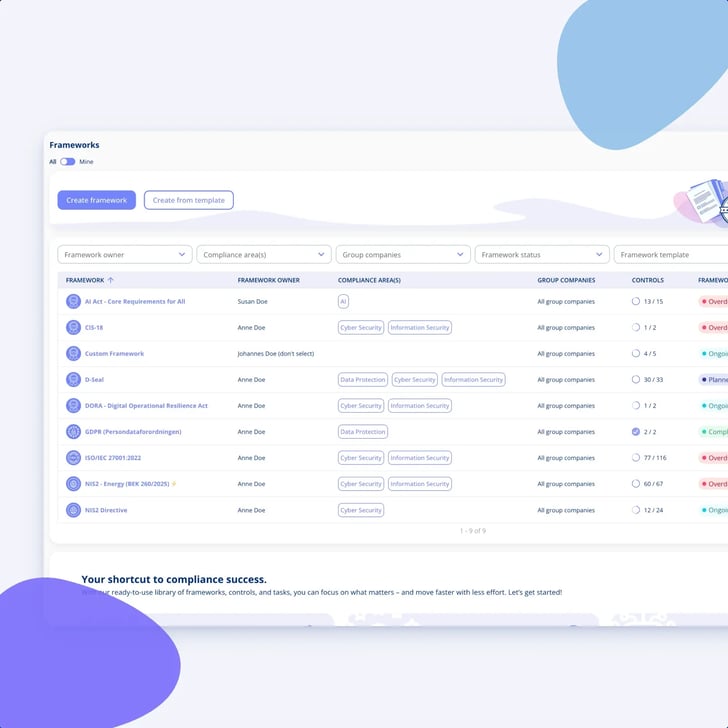
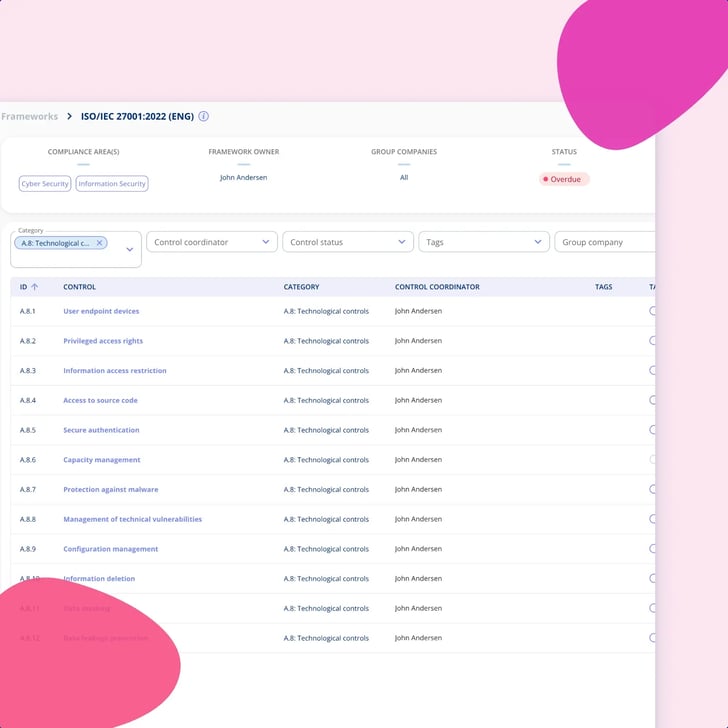
ISO 27001, NIS2 and a long list beside them arrive with their controls already built. At control level the ids and naming are 1:1 with the standard, so an auditor recognises what they are looking at.
An information security management system is the frameworks you answer to, the controls beneath them and the documentation that proves the work happened. In .legal you run all three in the Frameworks module. We build the plan, not the filling-in.
Unlimited users • Free onboarding and support • No commitment

Anders Krogh is CISO at Meridian Nordic, an energy company that is an NIS2 essential entity and holds an ISO 27001 certification. His management system used to be a folder of policy documents, a spreadsheet of controls and a calendar of reminders he maintained himself, so the audit was always preceded by a fortnight of reconstruction. Now the frameworks he answers to are switched on in the Frameworks module, the controls sit beneath them with the standard's own numbering, and each control carries the tasks that document it, owned by the colleague who actually does the work. Anders works from the overdue list instead of from memory.
Run it in Frameworks
Activate the frameworks you answer to, work the controls beneath them, and document against them. One module, not five tools.
The plan, not the filling-in
You get the plan, the to-do list, the structure and the place the evidence goes. What the documentation says stays yours.
A record, not a detector
The platform documents security work. It does not scan, and it is not a SIEM. We would rather say that before the demo than after.
Progress, not a verdict
Framework status moves as tasks are completed. There is no single green light, because that number would not survive an auditor.
An information security management system is not a screen you open. It is the frameworks you answer to, the controls beneath them, and the documentation that shows the work was done, and in .legal all three live in the Frameworks module.

That sentence is ours and it belongs near the top, because it is the shortest honest description of the product. You get the structure and the road map. The content is your work.

Customers arrive confused about this, sometimes in the same sentence, and it is a fair confusion between two four-letter acronyms. So here it is plainly: the platform documents security work, it does not watch your services.
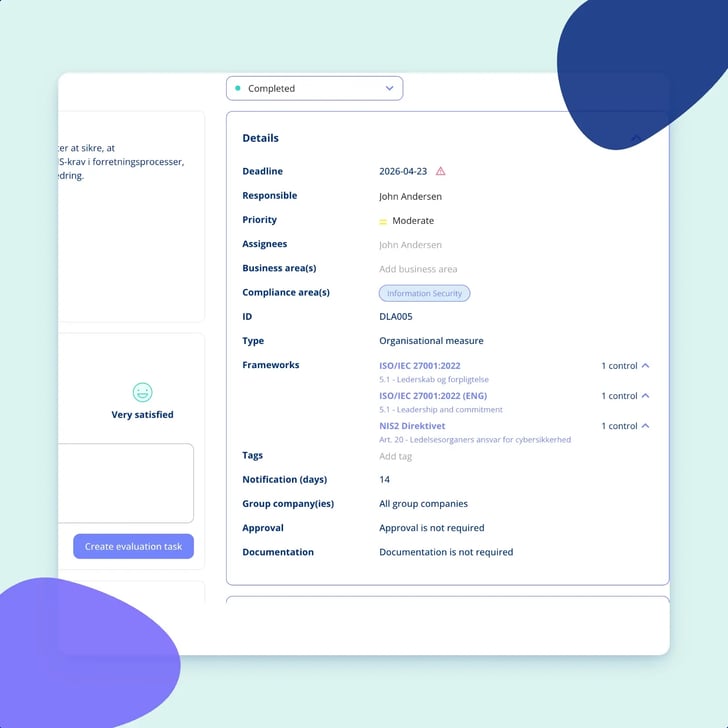
Your frameworks share one catalogue of tasks, over 300 activities at launch, each mapped in advance to the controls it satisfies. One completed task moves more than one thing.
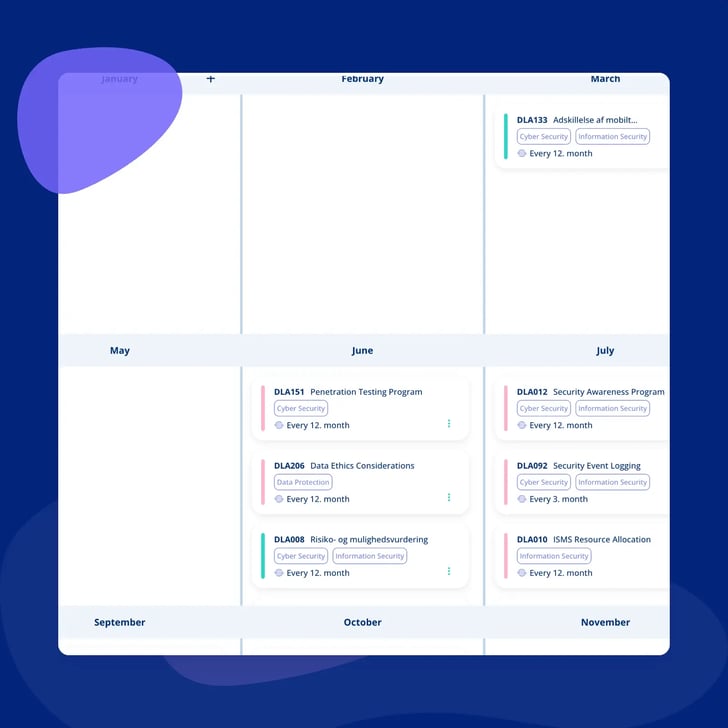
A control nobody performs is just a document. Every recurring control lands as dated tasks on one annual wheel (årshjul), with an owner and a frequency you set.

There is no single green light per framework, and we would rather explain why than invent one. What you get are measures of how far you are, judged by work you are already doing.
ISO 27001, NIS2 and a long list beside them arrive with their controls already built. At control level the ids and naming are 1:1 with the standard, so an auditor recognises what they are looking at.
Under each control you create the concrete tasks that have to be documented and set a frequency in weeks, months or years. The evidence is attached to the task, and when the frequency expires the task comes back.
The tasks sit below the frameworks in a catalogue that launched with over 300 activities, each mapped in advance to the controls it satisfies. Complete one, and every framework it belongs to moves with it.
Every recurring control lands as dated tasks on one annual wheel (årshjul) you can filter per framework. Overdue work is red and sorted to the top, with drill-down to the control, the task and the person.
Write and version the policy in the platform and link a section to controls in an active framework. The control's current status is pulled up into the policy, and from the control you see which policies it is anchored in. Requires the Policy Management add-on.
The controls point at things, so the things are registered next to them. Assets hold IT systems, OT and other asset types on your own templates, with the vendors and processing activities attached to each one.
Two frameworks, one management system underneath.
ISO 27001
The Annex A controls predefined and 1:1 with the standard, with the documentation gathered against them and the Statement of Applicability downloadable as Excel from the framework.
NIS2
Structured at article level and standing on the same controls and the same tasks as your ISO work, with the Danish national and sector rules activatable alongside the base package.
Run your ISMS and meet NIS2, ISO 27001 and more in one place.
Explore Information Security Managementcompanies
users
contracts
processing activities
Bech-Bruun
Mikkel Friis Rossa (Partner)
Fenerum
Rasmus Boutrup (Financial Controller)
Lægeforeningen
Michael Berner (Lawyer)
Molecule Consultancy
Nanna Rodian Christensen (HR & Operational Manager)
Plum Safety
Ulrik Dueholm Beckmann (QC, CM og ESG Lead)
Bech-Bruun
Mikkel Friis Rossa (Partner)
Fenerum
Rasmus Boutrup (Financial Controller)
Lægeforeningen
Michael Berner (Lawyer)
Molecule Consultancy
Nanna Rodian Christensen (HR & Operational Manager)
Plum Safety
Ulrik Dueholm Beckmann (QC, CM og ESG Lead)
Novicell
Julie Oxenvad (Legal Consultant)
Min By Media
Tinna Schultz (HR Manager)
DMJX
Kaspar Rochholz (GDPR Coordinator)
Axel Kaufmann ApS
Julie Lundkvist Andreasen (Lawyer and Head of Costumer Service)
NRGi
Mette Mühlendorph (Compliance Specialist)
Novicell
Julie Oxenvad (Legal Consultant)
Min By Media
Tinna Schultz (HR Manager)
DMJX
Kaspar Rochholz (GDPR Coordinator)
Axel Kaufmann ApS
Julie Lundkvist Andreasen (Lawyer and Head of Costumer Service)
NRGi
Mette Mühlendorph (Compliance Specialist)
Every use case is a real piece of compliance work, told the way it actually runs in the platform. Filter by who you are, what you work with, and which frameworks you answer to.
6 use cases
No use cases match that combination yet. Try removing a filter.

An information security management system, usually shortened to ISMS, is not a separate screen in the platform. It is the frameworks you answer to, the controls beneath them and the documentation you produce against those controls. You run it in the Frameworks module: activate ISO 27001, NIS2 or another framework, work the controls that come with it, and document against them.
No, and the two get mixed up often enough that we would rather say so plainly. .legal is a documentation platform. It does not scan anything and it never derives a status from security breaches found automatically, which is exactly what a SIEM does. Incidents are registered by a person on a template, with the documentation attached afterwards. If a SIEM is what you need, this is not it and it does not replace one.
No. The frameworks come predefined, and at control level the ids, numbering and naming match the standard 1:1. Underneath each control sit the tasks that document it, and those come from .legal's own catalogue, so the descriptions and practical tips at that level are our words rather than the standard's. That distinction matters if you were planning to stop reading the official documents.
What the Annex A controls areNo. We build the plan, not the filling-in. You get a plan, a road map, a structure and the place the evidence goes, so you know where to start and where it ends. What the documentation actually says is your work. .legal is a compliance software vendor rather than a law firm, so there is no advice and no final stamp that says you comply.
No, and that is deliberate. What you get is status per line, documentation progress on a framework you have activated, and a view of how far you already are towards a framework you have never set up, read off the tasks you are already doing. None of those is a verdict that says you comply. A control part-way through its documentation is not the same thing as a control nobody has under control, and a single green light would not survive an auditor asking how it was calculated.
Because the tasks sit below the frameworks rather than inside them, in one shared catalogue that launched with over 300 activities. .legal has mapped each task to the controls it satisfies, in one framework or across several, so completing it and documenting it moves progress everywhere it belongs. Framework status updates itself from tasks being completed across the organisation, so nobody maintains a status field by hand.
Under each control you create the tasks that have to be documented, set a frequency and give each one a named owner. The owner gets the task, attaches the evidence and closes it, and when the frequency expires it comes back with a reminder. Overdue work is red and sorted to the top, and you can drill from the framework to the overdue control to the task to the person responsible.
No. There are no integrations to your own systems for this today, so the evidence is fetched by hand, typically as a screenshot or an export from the system it comes from, and uploaded to the task. It is where we would like to get to, and it is not where we are, so a page that implied otherwise would be selling you something we do not have.
Yes. Filter the activities and the calendar down to ISO 27001 and you work in that framework's own picture, control by control, with the documents attached to each one. The Statement of Applicability downloads as Excel from the ISO framework. Sharing the tasks underneath does not collapse the frameworks on top, which is what lets an auditor see the documentation in the context they are auditing.
What a Statement of Applicability isNo. Users are unlimited, external users included, so the colleague in IT or operations who actually performs the check can get the task and document it themselves. A role can also be stripped down to the few menu items a pure task doer needs, and that part is role administration, which needs the Advanced User Management add-on.
What identity management covers
Info
.legal A/S
hello@dotlegal.com
+45 7027 0127
VAT-no: DK40888888
Support
support@dotlegal.com
+45 7027 0127
Need help?
Let me help you get started
.legal is not a law firm and is therefore not under the supervision of the Bar Council.