A summary on every system
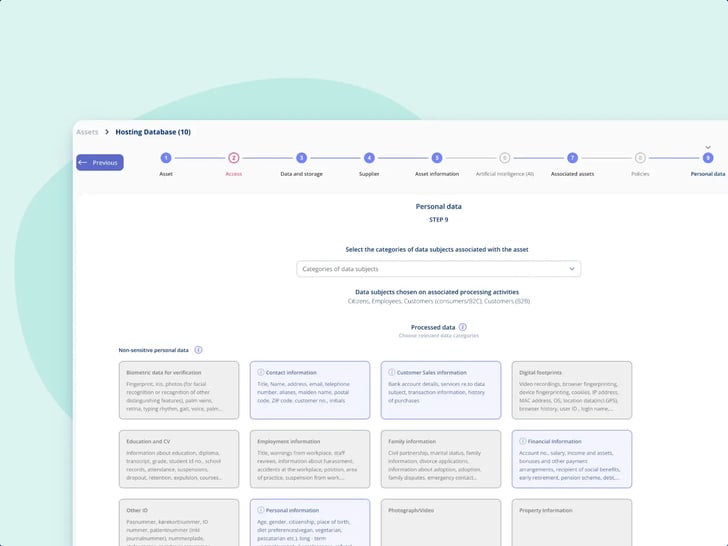
Every system shows the personal data in it, gathered from all the processing activities it's attached to, so the question can start with the system rather than with each activity.
Modules
.legal AI
All AI features →Integrations
See all integrations →Platform & features
Understand the rules
See it in action
All customer stories →Plan your switch
Stay up to date
Open a system and see which personal data sits in it, gathered from every processing activity it's attached to, with a summary on the vendor behind it as well. Nothing is discovered for you: every entry is one a colleague registered, which is why you can stand behind it.
Unlimited users • Free onboarding and support • No commitment

Data mapping
When IT announced that Meridian's old customer portal would be switched off in the spring, the first question landed with Sofie Bruhn, as it always does: what personal data is actually in it, and what depends on it? She used to answer that by reading processing activities one at a time and hoping the list was complete. This time she opened the portal itself. It showed the personal data gathered from every activity it was attached to and which activities those were, and the vendor behind it showed the summary too. Anders Krogh, who owns the asset register on the security side, was looking at the same system.

Start from the system
Open the system and read which personal data sits in it, gathered from every processing activity it's attached to.
The purpose sets the limit
When you attach a system to an activity, you can only pick personal data that activity already covers.
Per company, where it differs
With group companies, part of the Enterprise plan, mark which companies use the system on each activity, even when the activity spans several.
As fine as you need
Stay at category level, or add your own personal data types beneath it. Nothing is lost if you don't.
Data mapping
Auditors, IT and customers rarely ask about a processing activity. They ask about a system, and when the documentation is built around activities, that's a slow question to answer.
Data mapping
Activities, systems and vendors are mapped to each other, and the record page tells that side of it. This page starts at the other end, with the system.
Data mapping
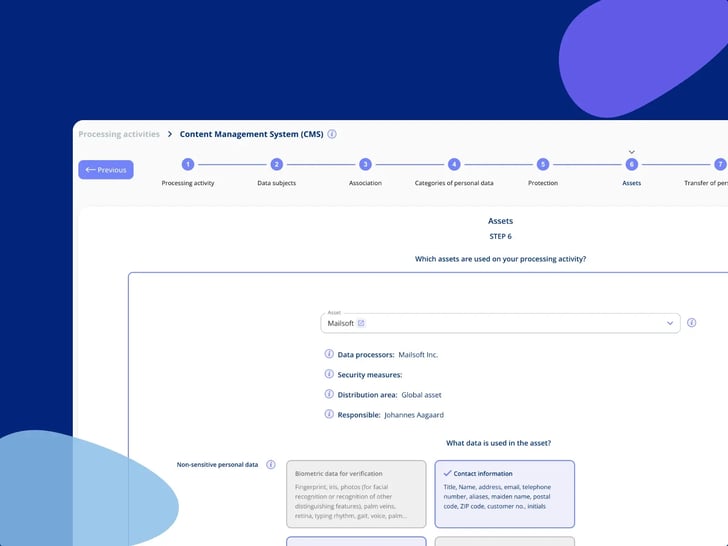
When you attach a system to a processing activity, you pick its personal data from what that activity already covers. Nothing else is on offer.

Data mapping
Personal data categories are the general level. Beneath them you can add your own personal data types (name, email address or physical address, for instance) when the questions you get need that detail.

Data mapping
Assets are no longer only systems that process personal data. Anders Krogh documents Meridian's IT and OT in the same register Sofie maps against, and personal data is one way of describing an asset rather than the definition of one.

Data mapping
Mapping is the clearest place to see where .legal stops. We build the plan, not the filling-in.
Every system shows the personal data in it, gathered from all the processing activities it's attached to, so the question can start with the system rather than with each activity.
The vendor behind the system shows the summary too, so the question can start from either end.
Attaching a system to a processing activity offers only the personal data categories registered on that activity, and you take the ones the system holds.
With group companies, part of the Enterprise plan, mark which group companies use the system on each processing activity, even when the activity covers several of them.
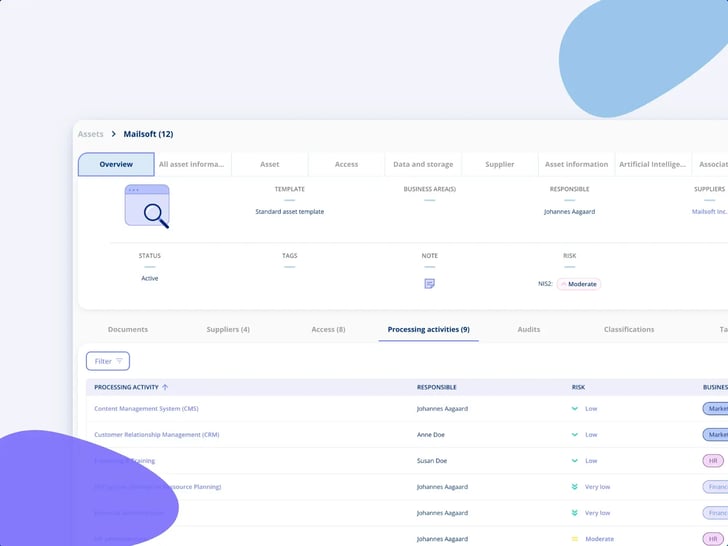
Every system lists the activities it's associated with, with the responsible person, risk score and business area, filtered by what the user has access to.
Your own granular layer beneath the categories, created in master data and attached on the activity, the system and the processor. Optional, and the categories carry on working without it.
Data mapping
GDPR, read from the systems that carry it.
GDPR
Your record of processing is GDPR work, and the systems behind it are usually where the questions start. This is the same documentation, read from the system's end.
Document GDPR and keep Article 30 records current. This is where your processing activities are kept, and every system on this page is read through them.
Explore GDPRRun your information security management system and meet NIS2, ISO 27001 and more in one place. It's also where Anders keeps the asset register this page maps against.
Explore Information Security Managementcompanies
users
contracts
processing activities
Bech-Bruun
Mikkel Friis Rossa (Partner)
Fenerum
Rasmus Boutrup (Financial Controller)
Lægeforeningen
Michael Berner (Lawyer)
Molecule Consultancy
Nanna Rodian Christensen (HR & Operational Manager)
Plum Safety
Ulrik Dueholm Beckmann (QC, CM og ESG Lead)
Bech-Bruun
Mikkel Friis Rossa (Partner)
Fenerum
Rasmus Boutrup (Financial Controller)
Lægeforeningen
Michael Berner (Lawyer)
Molecule Consultancy
Nanna Rodian Christensen (HR & Operational Manager)
Plum Safety
Ulrik Dueholm Beckmann (QC, CM og ESG Lead)
Novicell
Julie Oxenvad (Legal Consultant)
Min By Media
Tinna Schultz (HR Manager)
DMJX
Kaspar Rochholz (GDPR Coordinator)
Axel Kaufmann ApS
Julie Lundkvist Andreasen (Lawyer and Head of Costumer Service)
NRGi
Mette Mühlendorph (Compliance Specialist)
Novicell
Julie Oxenvad (Legal Consultant)
Min By Media
Tinna Schultz (HR Manager)
DMJX
Kaspar Rochholz (GDPR Coordinator)
Axel Kaufmann ApS
Julie Lundkvist Andreasen (Lawyer and Head of Costumer Service)
NRGi
Mette Mühlendorph (Compliance Specialist)
Every use case is a real piece of compliance work, told the way it actually runs in the platform. Filter by who you are, what you work with, and which frameworks you answer to.
22 use cases
No use cases match that combination yet. Try removing a filter.

No. Nothing scans, crawls or connects to your systems, and there's no automated discovery of any kind. Every entry in the mapping is registered by a person who knows the system. That takes longer to build than a scan promises, and in return the mapping says what your organisation has decided is true, which is what an auditor will ask you to stand behind.
From the processing activities it's attached to. Each time you attach a system to an activity, you choose which of that activity's personal data the system holds. The system then shows all of it gathered together, across every activity it's attached to, and the vendor behind the system shows the summary too. So the answer for a system is only ever as complete as the activities behind it.
When the question is about the vendor's agreement insteadBecause the list you pick from is the processing activity's own categories. A system can only be mapped to personal data the purpose already covers, which keeps the mapping honest. If a system really does hold something the activity doesn't list, that's a question about the activity, and it gets answered there first.
No. Categories are the general level, and they answer a lot of questions on their own. If you need more detail, you can create your own personal data types in your master data, map them to the categories you already use, and attach them on the activity, the system and the processor. It's optional, and nothing you've mapped at category level is lost if you never use them.
No. You can go in from whichever corner you know: the system, the processing activity or the legal entity. IT usually knows the systems and the business usually knows the activities, so the mapping can be built from both ends and meet in the middle.
On each attachment. When you attach the system to a processing activity, you mark which group companies use it there, even when the activity itself applies to several. That's where the difference between companies actually sits, so that's where it's recorded. Group companies themselves are part of the Enterprise plan.
Not today. Replacing a system is manual: you create the new asset, find the processing activities the old one is attached to, remove it on each and add the new one. The old system's own list of processing activities is where you find them, and as long as you have access to all of them, the list of places to change isn't guesswork. We won't promise a date for anything better.
There's no bulk import of assets we can point you to, so plan on registering systems in the platform. If you're coming from spreadsheets altogether, getting your existing documentation in is a separate conversation, and it's worth having before anyone starts typing.
Mapping personal data to a system needs the Information Security Management module alongside GDPR / Data Protection, because the personal data fields on the asset come with it. That fits how the register is used anyway: it's the module Anders works in, so the systems he documents and the ones Sofie maps are one register.
Only the ones they have access to. The system's Processing activities tab lists the activities it's associated with, with the responsible person, risk score and business area, and the list is filtered by the user's access. Two colleagues can open the same system and see different lists, and that's intended.
What access control means