
ADD-ON · ENTERPRISE RISK MANAGEMENT
A level four is hard to decide on. A number isn't.
Put money on the exposure, meaning what it costs you if the risk becomes real, and money on the plan, meaning what it costs to reduce it and where the exposure lands afterwards. Then you have a calculation instead of a colour.
 Watch the video

.png?width=68&height=52&name=bws_shipping_rgb%20-%20Kopi%20(2).png)






.jpeg?width=131&height=26&name=right_people_logo%20(1).jpeg)

.jpg?width=58&height=26&name=Praktiserende%20L%C3%A6gers%20Organisation%20(1).jpg)
.jpg?width=108&height=26&name=finans%20danmark%20(1).jpg)


.jpg?width=89&height=26&name=klasselotteri%20(1).jpg)

-1.png?width=34&height=26&name=bws_shipping_rgb%20-%20Kopi%20(2)-1.png)



.jpeg?width=135&height=26&name=AH%20industries%20(1).jpeg)






.jpg?width=225&height=26&name=KAUFMANN%20(1).jpg)




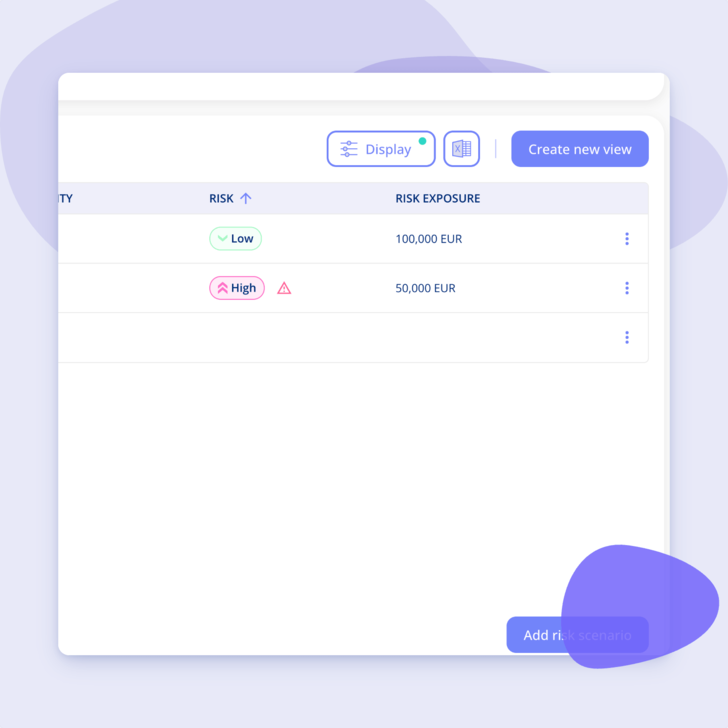
Risk levels don't translate into decisions
A scale is excellent for comparing risks to each other. It's much weaker the moment someone has to weigh a risk against an investment, an insurance premium or a budget line. That's the conversation a board is actually having.
-
Comparable to something: A figure can sit next to other figures. A level four can't.
-
Two sides to price: What the exposure is, and what it costs to bring it down.
-
Not instead of the scale: Some areas run perfectly well on levels alone. Currency is there when you need it.
Put a number on the decision
A short look at exposure, cost and the calculation between them.

.png?width=728&height=728&name=Set%20financial%20exposure%20on%20risk%20scenario%20(1).png)
Put a figure on the exposure
Risk exposure is the estimated financial loss if the risk materialises.
-
On the assessment itself: Recorded alongside consequence, probability and the justifications, not in a separate sheet.
-
Optional by design: Use it where it adds something. Areas that work fine on the scale alone can ignore it entirely.
-
Consistent across entities: The same field on every assessment, so the numbers can actually be added up.

Price the mitigation plan
An action plan can carry both a cost and an expected exposure after completion.
-
What it costs to do: Give the plan an estimated cost, so approving it is a real trade-off rather than a formality.
-
Where it lands: Record the expected financial exposure once the plan is completed.
-
Decision support built in: Risk area owners and management can see both figures in the same view as the plan itself.
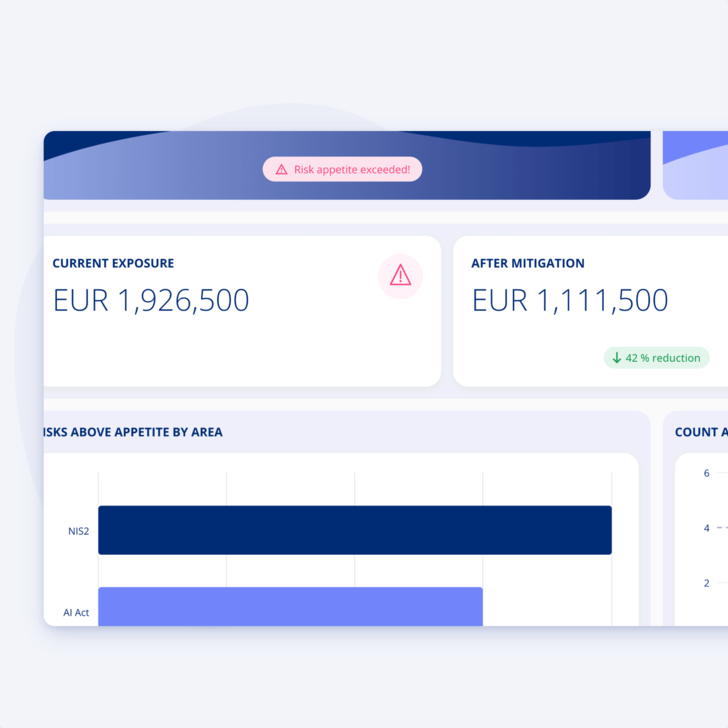
See the calculation
Exposure today, exposure after the plan, and what closing that gap costs.
-
The difference is the point: How much exposure the plan removes is usually more persuasive than either figure alone.
-
Comparable across plans: When several plans compete for the same budget, the numbers make the priority obvious.
-
Honest about estimates: These are estimates. The value is in the direction and the order of magnitude, not in the decimals.
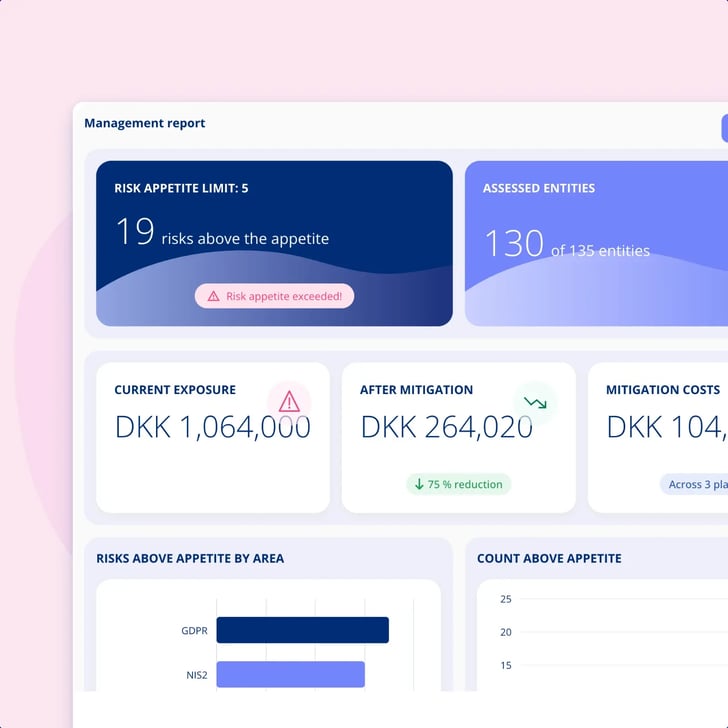
Numbers roll up on their own
What you record on a single assessment ends up in the reporting without anyone rebuilding it.
-
At area level: Total exposure for the area, alongside the other key figures.
-
In the management report: Exposure now, exposure once open plans are completed, and what those plans cost.
-
Across areas: One financial picture even where each area uses a different scale.

Getting You Started
Customer Support
-
You get a dedicated Customer Success Manager.
-
Personal onboarding to ensure a smooth start.
-
Support available Monday to Friday, 9 AM to 3 PM.

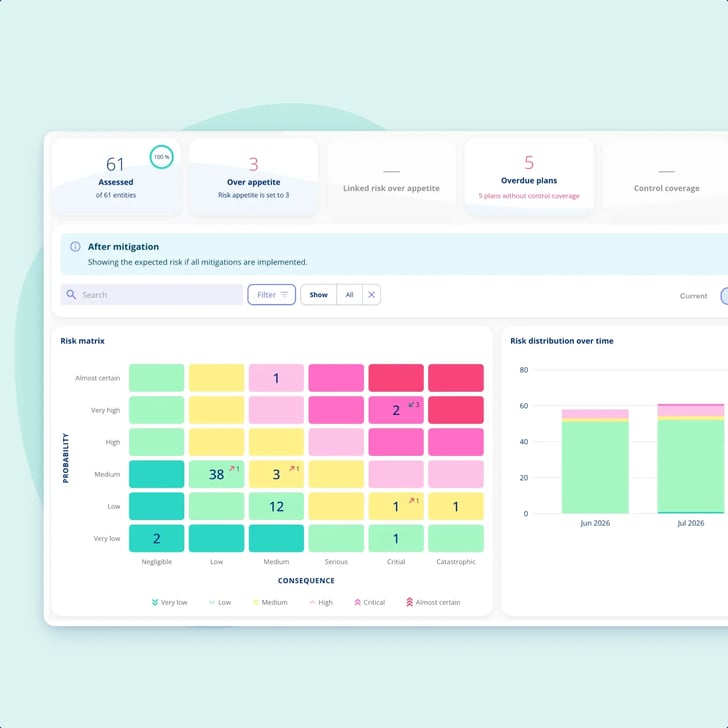
.legal compliance platform
Begin with Enterprise Risk Management today
-
Works alongside your existing frameworks
-
Free onboarding included
-
No commitment