
Free GDPR maturity assessment
How well do you handle the GDPR?
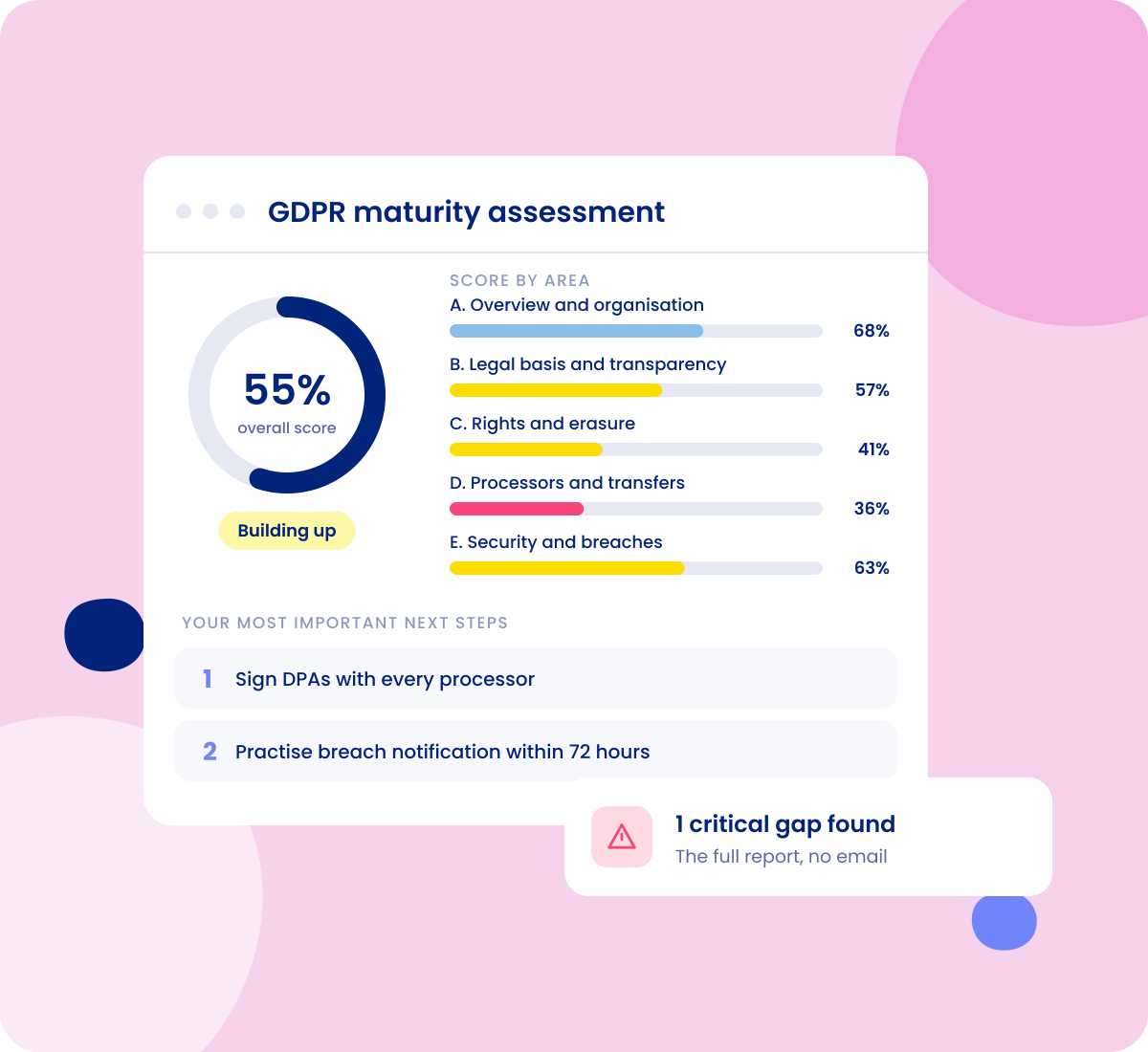
Answer 20 questions on your record of processing, legal basis, data subject rights, processors and breaches. See your score, critical gaps and your three most important next steps straight away.
- ✓ 20 questions · about 6 minutes
- ✓ The full report free, no email
- ✓ Built on the GDPR and the Danish Data Protection Act
Loading the assessment …
Five areas the supervisory authority also looks at
-
A. Overview and organisation
Record of processing, responsibility, DPO and policies.
-
B. Legal basis and transparency
Legal basis, sensitive data, consent and information to data subjects.
-
C. Data subject rights and erasure
Requests, access, retention periods and erasure in practice.
-
D. Processors and transfers
Overview, data processing agreements, oversight and transfers outside the EU.
-
E. Security, breaches and impact assessment
Security measures, breaches, DPIA and data protection by design.
Done is not the same as documented
Every answer puts you on the same scale. The GDPR does not only ask whether you do the right thing. It requires you to be able to show it.
-
Level 0
Not in place
-
Level 1
Informal or partial
-
Level 2
Done, but not documented or followed up
-
Level 3
Documented and followed up
What you get, with no email
-
An overall score, a level and a score for each area
-
A warning for critical gaps and your three most important next steps
-
A one-page management summary with five decisions
-
The legal reference, next step, owner and evidence for each question
-
Who to ask about each "Don't know" and a 90-day plan
-
A link you can share and a version you can print
When you want to go further
Want to see what it looks like in a platform?
In 30 minutes we go through your result and show how you work with the GDPR in .legal, with the record of processing, processors and breaches in one place.
Book a demoHow the assessment is built
Each question points to an article in the General Data Protection Regulation and, where it adds something, to the Danish Data Protection Act. The references were checked against the legal text on 25 November 2026. Three questions are about good practice rather than a direct requirement, and the report says so.
The score is weighted. The record of processing, legal basis, requests, retention periods, data processing agreements, transfers, security and breaches weigh the most. Four questions are always critical, and two are critical depending on your answers at the start, such as the data protection officer for public authorities. If you answer 0 or "Don't know" to a critical question, your level can be "Building up" at most, whatever the overall score.
The assessment looks at you as a controller. It is not legal advice and does not determine your role in a specific processing operation. The Danish Data Protection Agency's guidance and the EDPB's guidelines are good places to read more.
Your answers are not stored by us. They stay in your browser and in the link you can share yourselves. We count anonymously how many people complete the assessment and how the scores are distributed, without cookies and without knowing who you are.
Frequently asked questions about the GDPR self-assessment
Does the assessment show whether we comply with the GDPR?
No. It measures how far you have come, based on your own answers. It is not an audit and not legal advice.
Read the GDPR guide
We are a public authority. Does the assessment fit us?
Yes. Choose "Public authority or public body" in the first step. The question on the data protection officer then becomes critical, and the report takes into account that you cannot rely on legitimate interests for your tasks as an authority.
We have fewer than 250 employees. Do we need a record of processing?
Typically yes. The exemption only covers occasional processing without risk and without sensitive data. Payroll and HR administration are not occasional.
Read about the record of processing
What is a critical gap?
An answer of 0 or "Don't know" to one of the questions that weigh the most: the record of processing, data processing agreements, transfers outside the EU and notifying breaches within 72 hours. For public authorities also the data protection officer, and with sensitive data or monitoring also the impact assessment. The level can then be "Building up" at most.
What happens if we answer "Don't know"?
The answer scores 0 and is counted separately. For each "Don't know", the report shows who you can ask internally and what to ask to see. Three or more "Don't know" answers are in themselves a sign that the overview is missing.
Do we have to give our email to see the report?
No. The full report is free and shown straight away. If you want to talk about what it could look like in a platform, you can book a demo.
Are our answers stored?
No, not by us. The answers stay in your browser and in the link you can share. If you book a demo, you are welcome to send us the link, and we will start from your result.