Obligations on the contract (add-on)
Register each duty with a checklist, an interval in weeks, months or years, and named responsible people. Requires the Obligations add-on, which you switch on yourself.
The work starts when the contract is signed. Register what each contract obliges you to do, delegate it to named colleagues as tasks with deadlines, and see in one overview that it gets done on time.
Unlimited users • Free onboarding and support • No commitment

Peter Lund is legal counsel at Meridian Nordic, whose archive holds contracts with around 1,200 suppliers, DPAs and NDAs included. The duties inside them, index-linked price adjustments, supervision of vendors, SLA reporting, used to live in his calendar and a spreadsheet only he could read. Now each duty is registered on its contract with a checklist, an interval and a named colleague in the department that actually performs it. Peter checks one overview instead of remembering everything himself.

Life after signature
Contract management here means administration: the contract, its people, its duties and its dates, once the agreement is made.
From duty to task
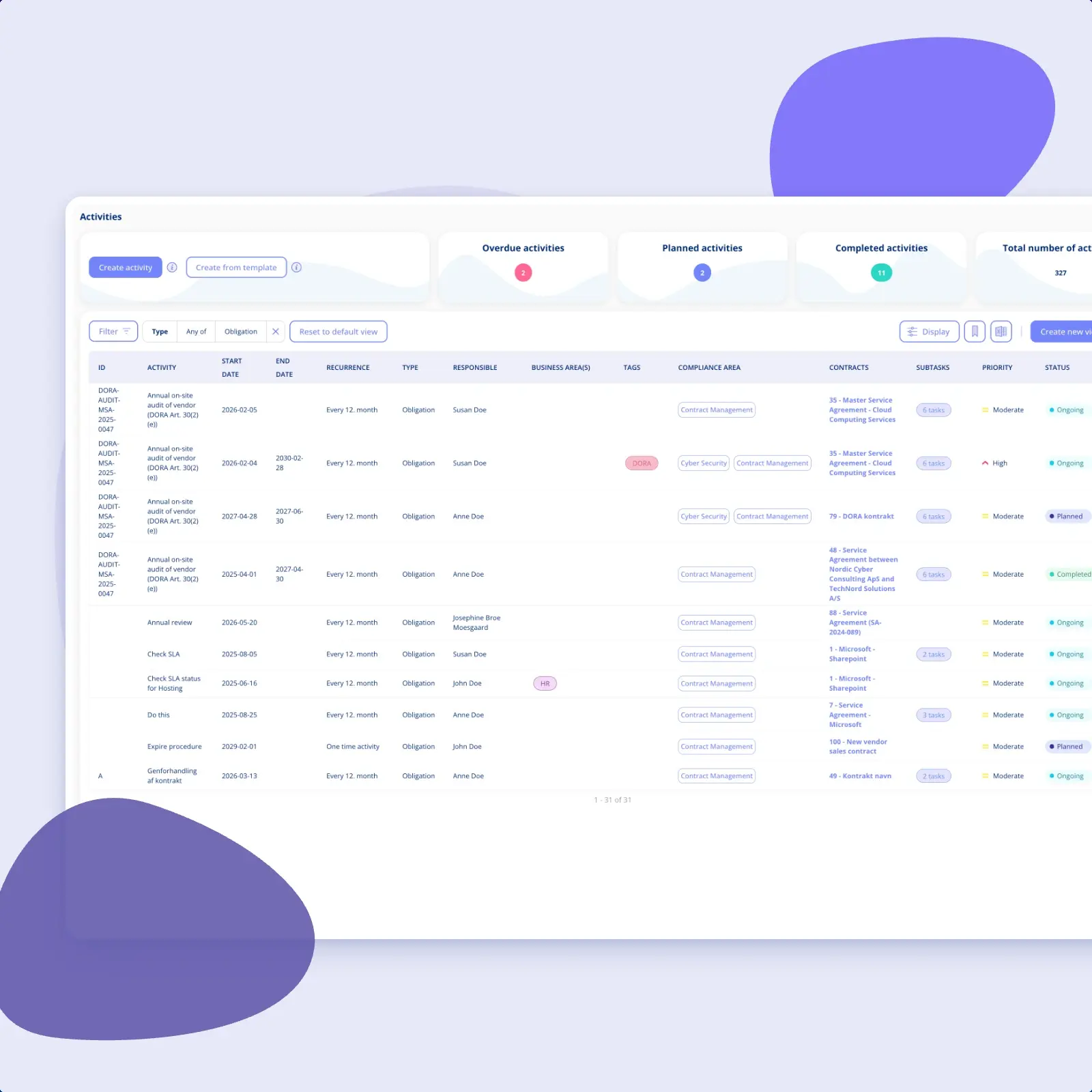
Every obligation becomes a task for a named colleague, with a deadline and an email when it's time to act.
Seen centrally
One overview across all contracts shows whether delegated obligations are done on time. Neglected ones show red.
Renewals in hand
End dates notify ahead of time, and automatic renewal updates the obligations that follow the contract.
Signing is the easy part to remember. The duties inside the contract, the price adjustment, the supervision, the reports, run for years, and they rarely belong to the person who signed.
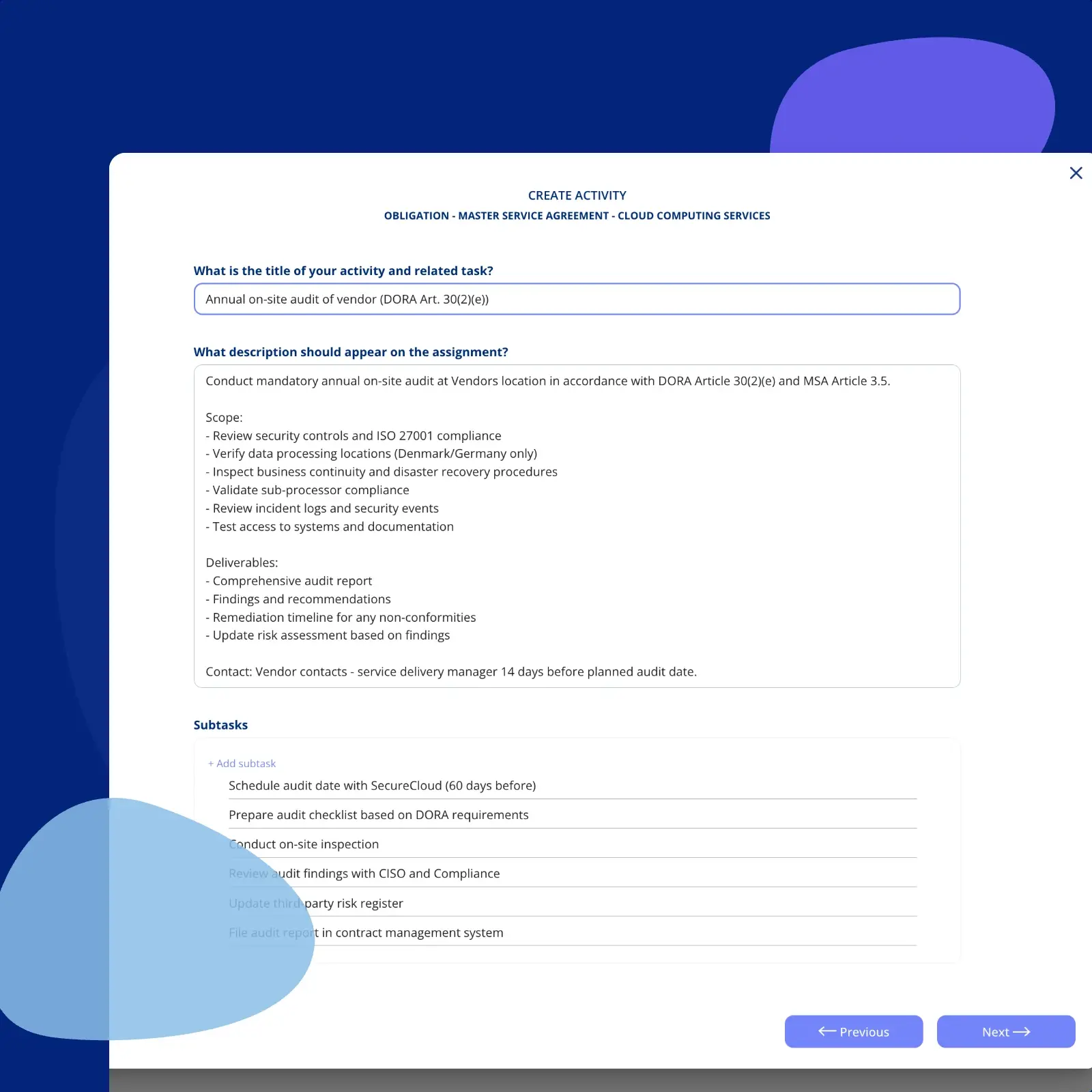
An obligation in .legal is a contractual duty that has to be performed repeatedly while the contract runs. You register it where it belongs, on the contract itself.
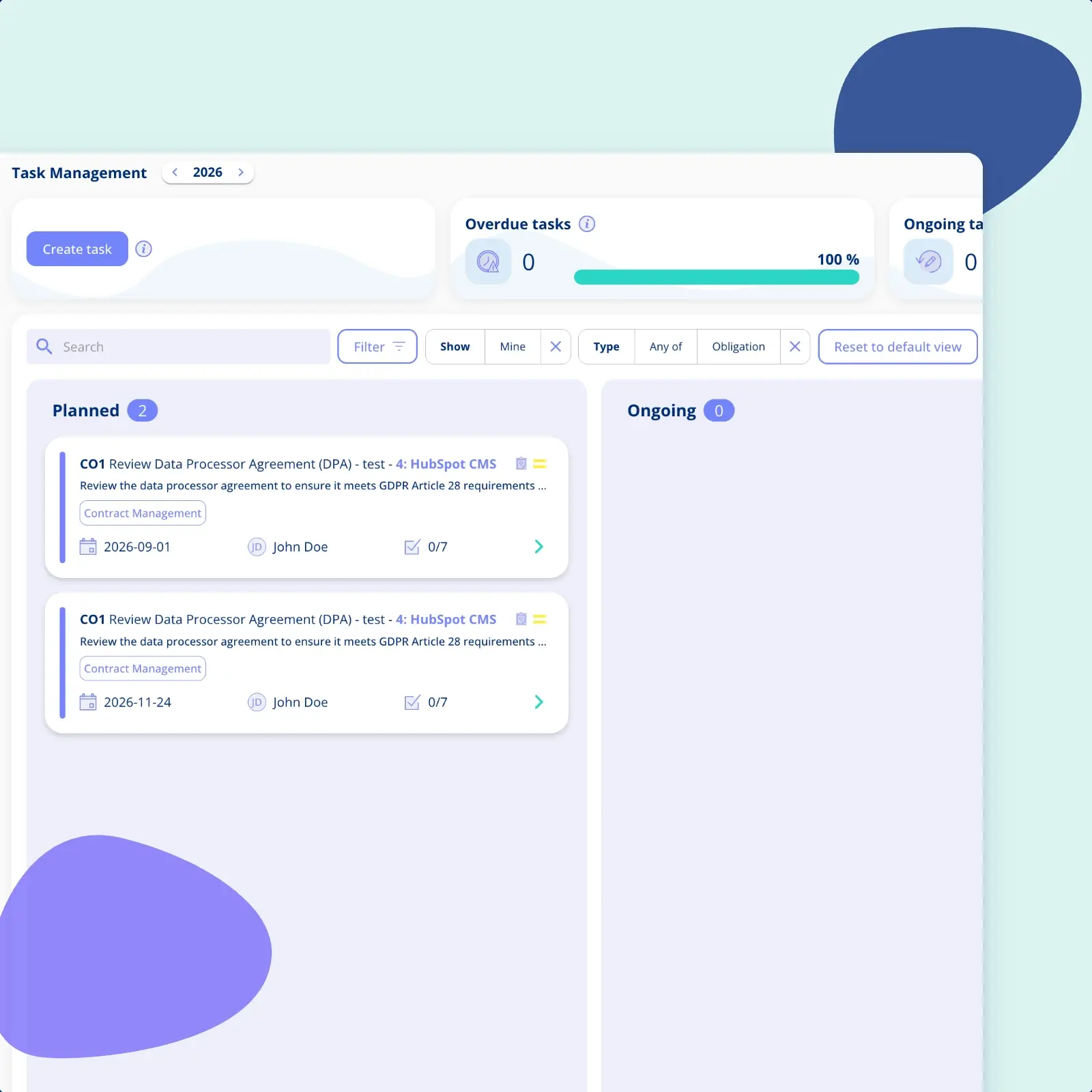
A record in an archive reminds nobody. Every obligation automatically creates a linked task, one per occurrence, on the same task board as the rest of your work.

A notice deadline written into a diary goes stale the day the contract is extended. In .legal a deadline can be relative to the contract itself.
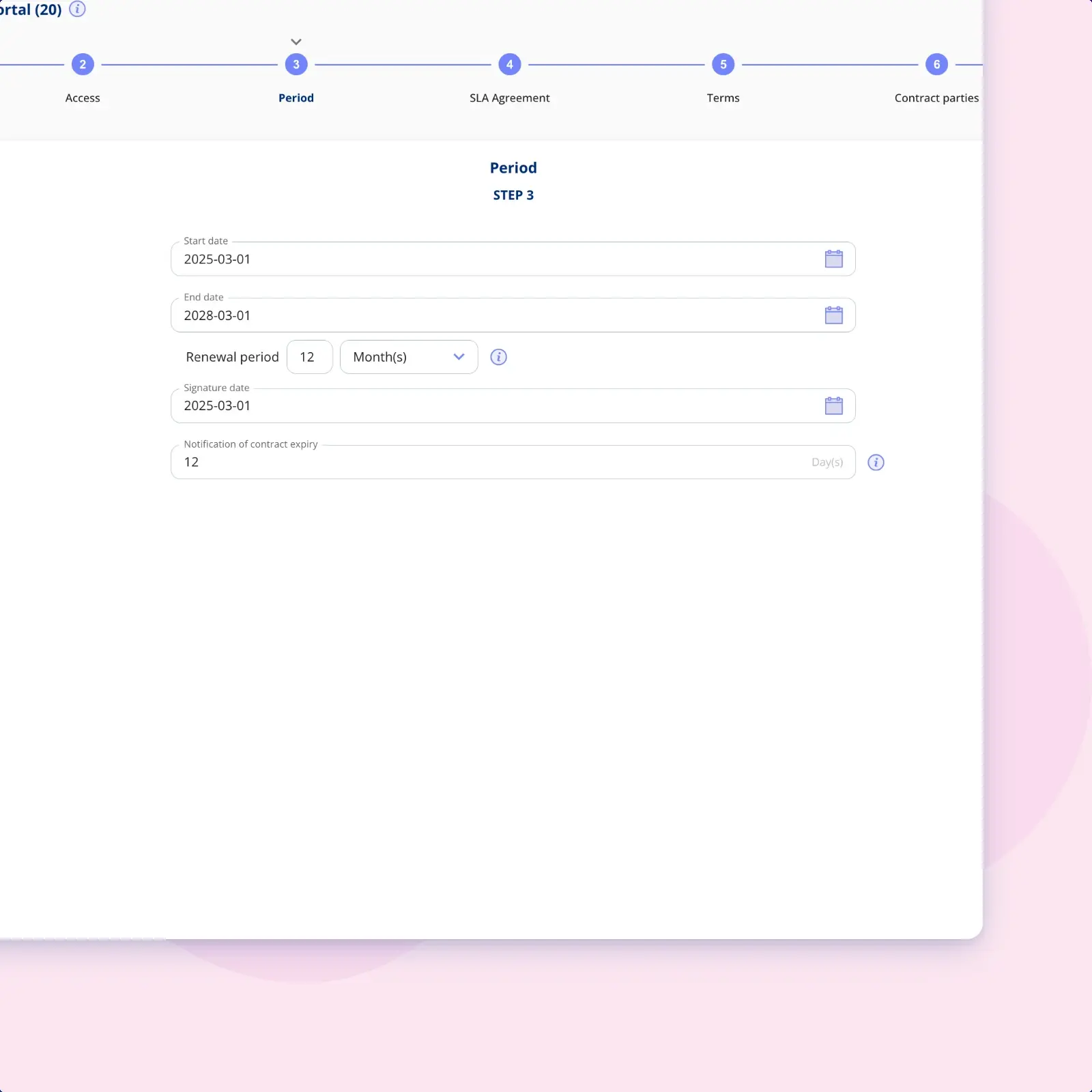
Renewal is where contract administration usually gets expensive. An end date in .legal is not just a field. It notifies ahead of time, and it can renew the contract for you.

We supply the scheduling, the notifications, the ownership and the record. What the contract obliges you to do is still your reading of it.
Register each duty with a checklist, an interval in weeks, months or years, and named responsible people. Requires the Obligations add-on, which you switch on yourself.
Set up a recurring duty once in master data and reuse it across contracts, or attach it to a contract template as required or optional.
Each occurrence becomes its own task. The responsible colleague gets an email when it's time, and completion is documented in the system.
Set a deadline as "30 days before the end date" and it adjusts itself when the contract's dates change, years ahead if needed.
Enable renewal per contract template with a renewal period. When the contract renews, obligations tied to its end date move with it.
Upload the signed document and AI fills the metadata fields of the contract template you choose. In beta, and what the contract obliges you to do stays your call.
Keep contracts, obligations and renewals in one overview.
Explore Contract ManagementManage your key obligations on all your contracts.
Explore Contract Obligationscompanies
users
contracts
processing activities

Bech-Bruun
Mikkel Friis Rossa (Partner)
Fenerum
Rasmus Boutrup (Financial Controller)
Lægeforeningen
Michael Berner (Lawyer)
Molecule Consultancy
Nanna Rodian Christensen (HR & Operational Manager)
Plum Safety
Ulrik Dueholm Beckmann (QC, CM og ESG Lead)
Bech-Bruun
Mikkel Friis Rossa (Partner)
Fenerum
Rasmus Boutrup (Financial Controller)
Lægeforeningen
Michael Berner (Lawyer)
Molecule Consultancy
Nanna Rodian Christensen (HR & Operational Manager)
Plum Safety
Ulrik Dueholm Beckmann (QC, CM og ESG Lead)
Novicell
Julie Oxenvad (Legal Consultant)
Min By Media
Tinna Schultz (HR Manager)
DMJX
Kaspar Rochholz (GDPR Coordinator)
Axel Kaufmann ApS
Julie Lundkvist Andreasen (Lawyer and Head of Costumer Service)
NRGi
Mette Mühlendorph (Compliance Specialist)
Novicell
Julie Oxenvad (Legal Consultant)
Min By Media
Tinna Schultz (HR Manager)
DMJX
Kaspar Rochholz (GDPR Coordinator)
Axel Kaufmann ApS
Julie Lundkvist Andreasen (Lawyer and Head of Costumer Service)
NRGi
Mette Mühlendorph (Compliance Specialist)
Every use case is a real piece of compliance work, told the way it actually runs in the platform. Filter by who you are, what you work with, and which frameworks you answer to.
5 use cases
No use cases match that combination yet. Try removing a filter.

The life of a contract after it is signed. You upload the contract, register the parties and metadata, and manage obligations, deadlines and renewals for as long as it runs. Drafting, negotiation and e-signing are deliberately not part of the platform, though signed contracts can be imported from Penneo.
A contractual duty that has to be performed repeatedly while the contract runs, like an index-linked price adjustment, supervision of a vendor, or the vendor's SLA reporting. You register it on the contract with a checklist, an interval and named responsible people, and it generates tasks with deadlines and email notifications.
What third-party risk coversNo. You decide what each contract obliges you to do and register it yourself, with templates to make the recurring ones fast. AI can help fill a contract's metadata fields when you upload the document (in beta), but it doesn't extract duties, and the judgement calls stay with you.
The contract period with expiry notifications is part of the contract module. Obligations, the duties you define, delegate and follow up on, are a separate add-on you can switch on yourself from My Account in the platform.
No, and we would rather say that plainly. Deadlines in .legal are scheduled and recurring, tied to the calendar or the contract's own dates. Nothing starts a clock from an inbound event, so a response deadline still needs a person to create the task.
Renewal is enabled per contract template with a renewal period. When the contract passes its end date it renews, and obligations tied to the end date are updated with it. The notification before a renewal comes from the expiry notification, where you set the lead time yourself. Archived contracts never renew.
When you archive the contract you are asked for an end date, and it closes the obligations that were still open. Planned future tasks outside the end date are removed, while tasks that are in progress or completed are kept, so the record of what was done survives the contract.
By default only the contract's Contract Manager, until access is actively granted, per business area or named user. Only users with access to the contract can be made responsible for its obligations, and the central overview shows each user only the contracts they can see.
How access control worksNo. Users are unlimited, so the colleague in operations who actually performs the duty can get the task and complete it themselves, without anyone weighing whether a licence is worth it.
Info
.legal A/S
hello@dotlegal.com
+45 7027 0127
VAT-no: DK40888888
Support
support@dotlegal.com
+45 7027 0127
Need help?
Let me help you get started
.legal is not a law firm and is therefore not under the supervision of the Bar Council.